The Government of India formulated the National Agroforestry Policy in 2014 in order to make agriculture less vulnerable to climatic aberrations. The policy recommends setting up a Mission or Board to address the development of the agroforestry sector in an organised manner. The Sub-Mission on Agroforestry (SMAF) under NMSA is an initiative to this end. The submission aims to expand the tree coverage on farmland in complement to crops. Let’s discuss, What is Sub-Mission on Agroforestry? and its objectives and guidelines.
Objectives:
Sub-Mission on Agroforestry will have the following objectives:
- To encourage and expand tree plantation in a complementary and integrated manner with crops and livestock to improve productivity, employment
- Opportunities, income generation, and livelihoods of rural households, especially the small farmers.
- To ensure the availability of quality planting material like seeds, seedlings, clones, hybrids, improved varieties, etc.
- To popularise various Agroforestry practices/models suitable for different agro-ecological regions and land use conditions.
- To create a database, information, and knowledge support in the area of agroforestry.
- To provide extension and capacity building support to the agroforestry sector.
Mission Strategy
To achieve these objectives for stimulating the growth of agroforestry in India, SMAF will have the following multi-pronged strategy:
- Tree plantation on farmlands suited to local climate and land-use conditions.
- Establishment of small and hi-tech nurseries to supply quality seeds, seedlings, clones, and improved varieties.
- Promotion of region-specific agroforestry models based on agroecology and land use.
- Peripheral and boundary plantations on agricultural fields.
- Low-density, strip, and high-density block plantations on farmlands.
- Digital database creation on agroforestry area, soil organic carbon, and knowledge support using ICT tools.
- Capacity building and training for farmers, officials, and scientists through demonstrations, workshops, exposure visits, and national & international exchanges.
- Implementation only in states with liberal timber transit rules, which is mandatory to avail the scheme benefits.
- State-designated implementing agencies will manage the programme as per NMSA guidelines.
- Promotion of endemic, medicinal, and locally suitable tree species; exotic or unsuitable species will not be supported.
- Soil Health Cards are mandatory to monitor soil carbon status and improvement over time.
- Use of high-quality planting material (bare-root or container seedlings) with balanced shoot and root systems for better survival.
- Physical verification of the plantation will be done by the competent authority of State Government
Trending blog: RKVY Agroforestry
Convergence with other Schemes
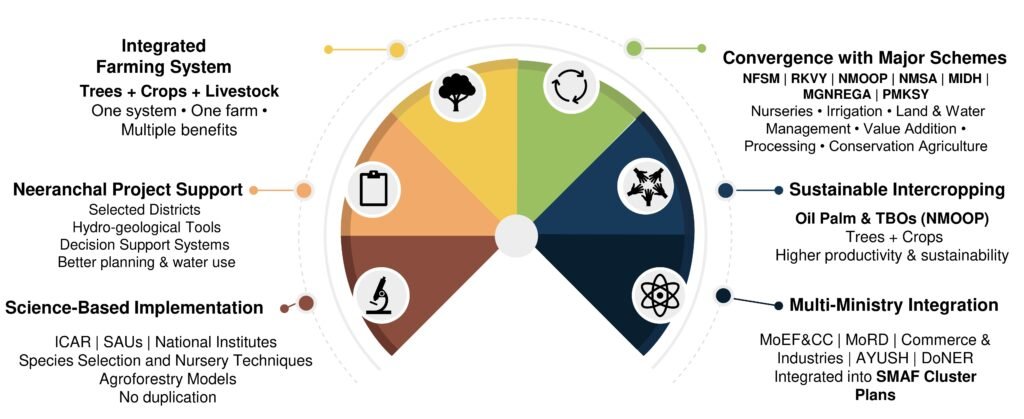
Project Activities
The Sub-Mission will have the following five broad components:
- Nursery Development for Quality Planting Material (NDQPM): SMAF prioritizes the production of high-quality seeds and planting material through registered nurseries. State governments may involve government agencies, PSUs, private players, and national/international institutions.
- Only endemic, locally suitable, and medicinal tree species will be promoted
- Exotic and ecologically unsuitable species are not supported
- Peripheral Boundary Plantation (PBP)
- Boundary plantation on farms is supported with four years of maintenance, including gap filling.
- 50% financial assistance is provided, released in phases: 40:20:20:20
- Plantation is measured in running meters and number of plants
- Low-Density Plantations on Farmlands (LDPFL)
- Designed mainly for small and marginal farmers, this includes strip, intermediate, and isolated planting.
- Financial support is released over four years (40:20:20:20)
- High Density Block Plantations (HDBP)
- Agroforestry block plantations starting from 1 hectare and above are supported with different spacing and planting densities.
- Assistance is provided in four annual phases (40:20:20:20)
- Demonstration of Agroforestry Models
- Support for area-specific and climate-resilient agroforestry models through ICAR, SAUs, CAUs, CSIR, ICFRE, and other agencies.
- Focus areas include carbon sequestration, nitrogen fixation, and climate adaptation.
- Capacity Building & Extension
- SMAF supports farmer training, skill development, awareness campaigns, exposure visits, workshops, and publications.
- States can use up to 5% of funds for capacity building and extension activities.
Coverage
- Only States/UTs with liberal timber transit rules can implement the programme immediately.
- Other States/UTs can access the benefits once transit relaxations are officially notified.
Mission Implementation Plan
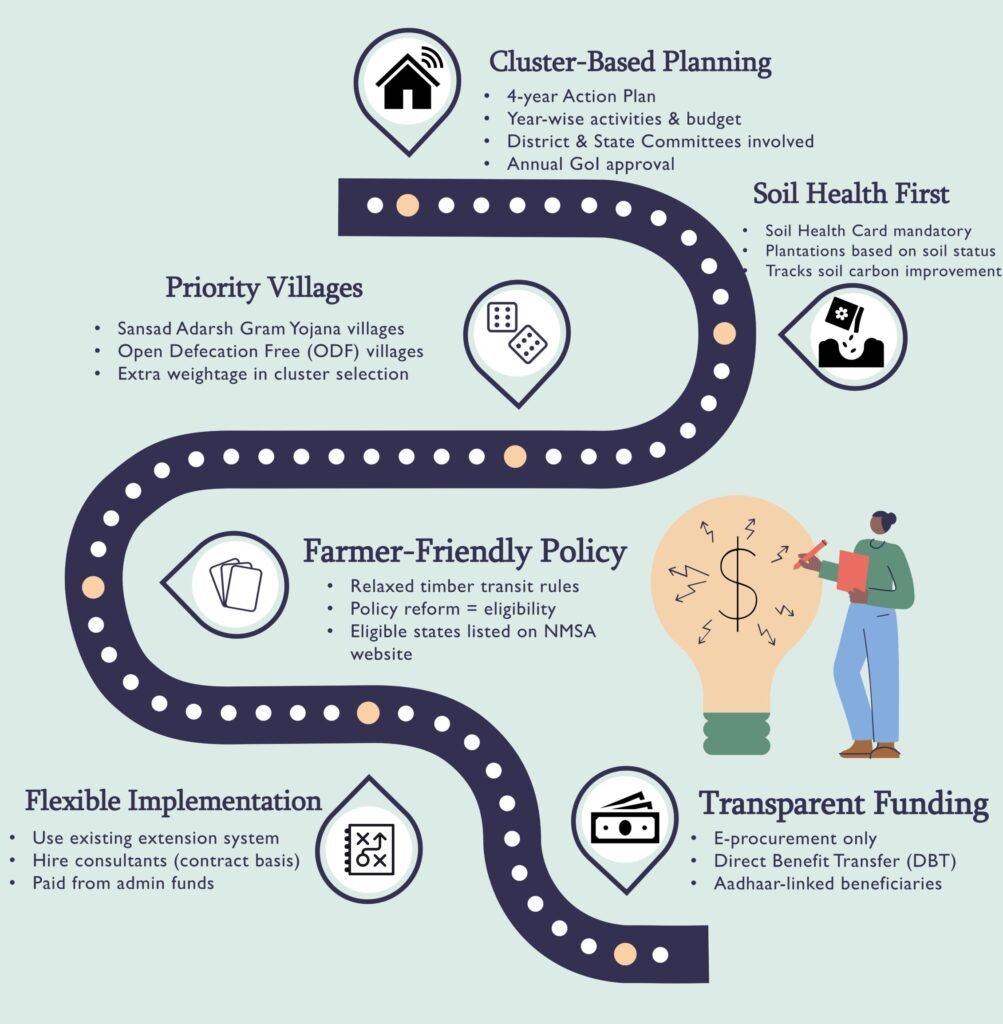
Funding Pattern & Pattern of Assistance
- Farmers-50% of the actual cost of the interventions (limited to 50% of the estimated cost) for the respective interventions.
- Farmers’ groups/ Cooperatives/Farmer Producers Organization (FPO): The assistance can be accessed as per norms and provisions applicable to the individual farmers.
- 60:40: State Govts basis for all states
- 90:10- 8 states of the NE Region and the hilly states of Himachal Pradesh, Uttarakhand, and Jammu & Kashmir
- 100%-For UTs
Fund Flow Mechanism
Annual Allocation: GoI shares tentative yearly funds with States → States prepare component-wise Action Plans.
Fund Release: After approval by the Project Sanctioning Committee, funds go to the State Nodal/Implementing Agency.
Installments: Released in phases based on physical & financial progress, UCs, and GFR norms.
Implementation: States ensure time-bound execution as per approved plans.
Administrative Cost: Up to 2% of annual outlay allowed at the national level.
Farmer Focus:
- ≥50% funds for small & marginal farmers
- ≥30% women beneficiaries
- 16% (SC) & 8% (ST) or as per district population
Local Participation: Panchayati Raj Institutions & farmer participation are mandatory.
Transparency: Beneficiary details displayed at Panchayat/Block offices and on official websites.
RKVY Agroforestry Scheme: Guidelines, Benefits & Support for Farmers


Leave a Reply