- Why Summer Irrigation Is Critical for Arecanut?
- Best Irrigation Methods for Summer Arecanut
- Why is drip irrigation better than sprinkler and flood irrigation in arecanut cultivation?
- Mulching: A Game-Changer for Summer Moisture Conservation
- Intercropping and Shade Management
- Application of Compost, Green Leaf Manure, Farm Yard Manure and Neem Cake
- Application of Pusa Hydrogel
Arecanut (Areca catechu L.) is a high-value perennial plantation crop, which is popularly known as betel nut or Supari. Betel nut, along with betel leaf offered to God and used during marriage and other religious ceremonies in Southern India. Arecanut inflorescences also play an important role in auspicious ceremonies. India is the largest producer and consumer of arecanut in the world. It is grown in the states of Kerala, Karnataka, Assam, Meghalaya, Tamil Nadu, and West Bengal. The area under areca cultivation is 2.60 lakh ha, yielding about 3.13 lakh tons of processed nuts. In India, Karnataka is the largest producer (40%), followed by Kerala (25%) and Assam (20%).
The cultivation of arecanut is mostly confined to 28º north and south of the equator. It grows well within the temperature range of 14ºC- 36ºC and is sensitive to low and high temperatures, affected by temperatures below 10ºC and above 40ºC. It can be grown in areas receiving annual rainfall of 750 mm in Maidan parts of Karnataka to 4,500 mm in Malnad areas of Karnataka. Irrigation is required in areas where there is a prolonged dry spell.
In dry and semi-arid regions, or even in high-rainfall areas that experience seasonal dry spells, improper irrigation during summer can lead to severe yield reductions, button shedding, nut tapering, and long-term decline in palm health. With climate variability increasing and water becoming a limiting factor, efficient irrigation management during summer is no longer optional-it is essential. This blog discusses scientifically proven and farmer-friendly strategies to manage irrigation in arecanut plantations during peak summer in semi-arid regions.
Why Summer Irrigation Is Critical for Arecanut?
Arecanut is a shallow-rooted crop, with most feeder roots concentrated in the top 30-60 cm of soil. During summer, moisture stress can cause depletion of soil moisture, increase evapotranspiration, increase physiological stress, and button drop and poor nut filling, which directly affects long term yield loss.
Hence, timely, adequate, and efficient irrigation is the backbone of summer arecanut management.
Understanding the Water Requirement of Arecanut in Summer
The water requirement of the arecanut varies with the age of the palm, soil type, climate, temperature, and method of irrigation.
Approximate summer water requirement:
- Young palms (1-5 years): 20-30 liters/day/palm
- Bearing palms (6-20+ years): 40-60 liters/day/palm
In peak summer, irrigation is usually required once in 4-7 days under conventional methods, but with micro-irrigation, water can be applied daily or on alternate days in smaller quantities.
Best Irrigation Methods for Summer Arecanut
1. Drip Irrigation– The Most Efficient and Highly Recommended
Drip irrigation supplies water directly to the root zone of each arecanut palm, reducing water loss through evaporation, runoff, and deep percolation. Drip irrigation is highly recommended for arecanut in dry regions due to its ability to:
- Deliver water directly to the root zone
- Reduce evaporation losses
- Improve water use efficiency by 30–50%
- Maintain uniform soil moisture
Best practices:
- Use 2-4 drippers per palm, depending on age
- Place drippers 60-90 cm away from the trunk
- Operate the drip daily or on alternate days during the summer
Studies from Karnataka and Maharashtra have shown that drip irrigation increases yield by 15-25% while saving 35-45% water compared to flood irrigation.
2. Basin Irrigation-If Drip is not available: In traditional arecanut-growing regions, basin irrigation is still common.
In summer, one can use the improved basin irrigation method by maintaining circular basins of 1.5-2 m radius. Apply water slowly to avoid runoff and irrigate during early morning or evening.
Irrigation interval:
- Sandy soils: every 3-4 days
- Red and loamy soils: every 5-7 days
Avoid water stagnation, as it can cause root rot and nutrient leaching.
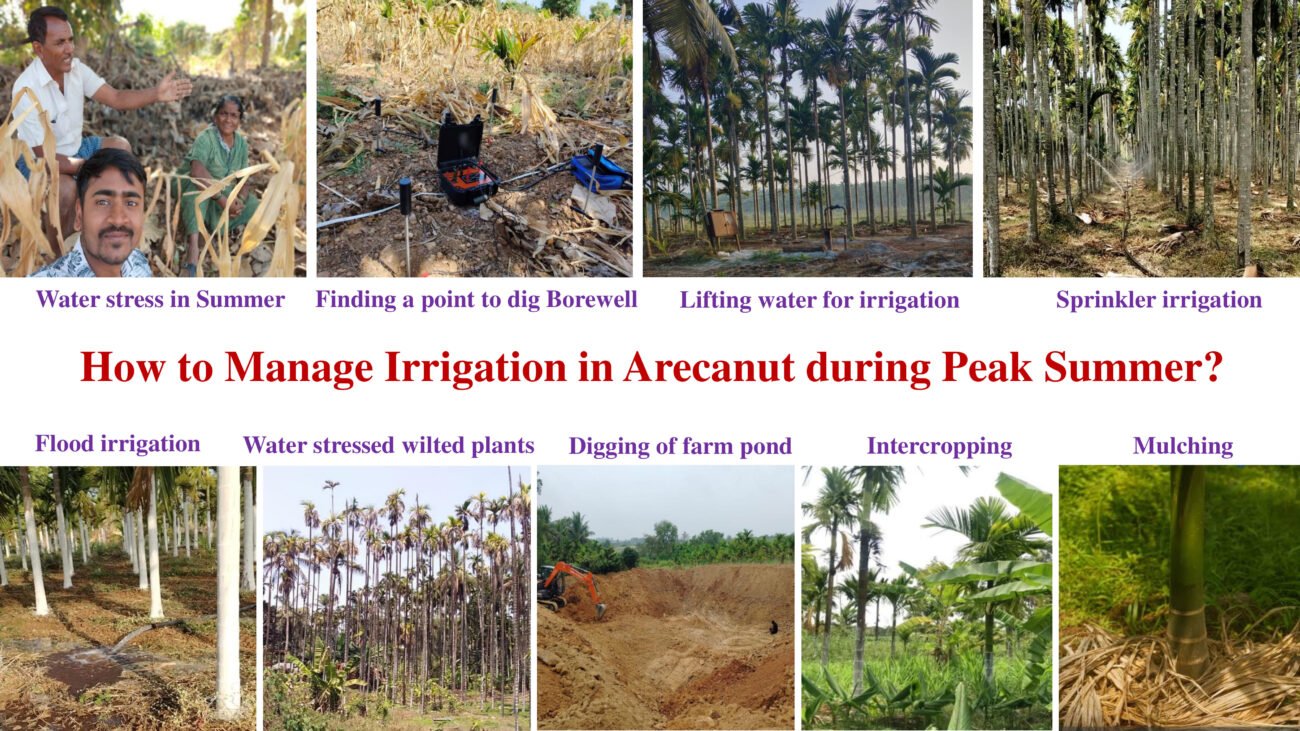
3. Sprinkler Irrigation -With Caution: Sprinklers can be used where drip installation is difficult, but avoid midday operation (high evaporation loss). Use only during early morning or late evening. Sprinkler irrigation is not recommended during flowering due to disease risk.
Why is drip irrigation better than sprinkler and flood irrigation in arecanut cultivation?
(Narendra et al., 2021; https://www.researchgate.net/publication/353179060)
A study from Karnataka revealed that drip irrigation is superior to sprinkler and flood irrigation in terms of water saving, yield, and economic returns in the drought-prone conditions of Chitradurga district. As a result, drip-irrigated gardens recorded the highest water use efficiency (9.81 litres per acre), compared to sprinkler (13.15 litres) and flood irrigation (19.18 litres). This means that drip irrigation produced more yield using much less water.
In terms of productivity, drip irrigation resulted in the highest average yield (9.62 quintals per acre), followed by sprinkler (8.56 quintals) and flood irrigation (8.22 quintals). Better soil moisture regulation under drip irrigation improves nutrient uptake, root growth, and overall plant health, which ultimately enhances yield.
Economically, drip irrigation proved to be the most profitable method. Even though the cost of cultivation was comparable across methods, drip irrigation generated the highest net returns (Rs. 2,14,151.06 per acre). The economic efficiency, measured as net returns per rupee spent on irrigation, was also highest under drip irrigation (Rs. 5.87), compared to sprinkler (Rs. 4.58) and flood irrigation (Rs. 3.89). This indicates better returns on investment for farmers adopting drip irrigation.
Overall, the study confirms that drip irrigation is the most efficient, water-saving, and economically viable irrigation method for arecanut cultivation in semi-arid and water-scarce regions like Chitradurga. Promoting drip irrigation can help farmers sustain arecanut production while conserving groundwater resources and improving farm income.
Mulching: A Game-Changer for Summer Moisture Conservation
Mulching is the practice of covering the soil surface with a layer of material (mulch) to conserve moisture, suppress weeds, regulate soil temperature, and improve soil health and fertility as organic mulches break down. Common organic mulches include straw, leaves, compost, and wood chips, while inorganic options like plastic sheeting are also used. Mulching is one of the most cost-effective and farmer-friendly practices to reduce summer water stress.
Benefits of mulching: Mulching reduces evaporation by 30-40%, maintains cool soil temperature, improves soil organic carbon, and enhances microbial activity.
Suitable mulch materials for arecanut plantation to reduce summer moisture stress are arecanut or coconut husk, dry leaves, coconut fronds, paddy straw, and weed biomass.
Apply mulch 10-15 cm thick in the basin area, leaving a small gap near the trunk to prevent collar rot.
Intercropping and Shade Management
Intercropping can indirectly support irrigation efficiency. Intercropping also helps to improve household income and provide seasonal employment opportunities.
Suitable summer intercrops: Banana (with controlled irrigation), Black pepper, Turmeric, and ginger (under partial shade).
Maintain optimum shade using mixed agroforestry species to reduce heat stress, especially in open plantations.
Application of Compost, Green Leaf Manure, Farm Yard Manure and Neem Cake
Application of Compost, Green Leaf Manure, Farm Yard Manure, and Neem Cake improves soil structure, water holding capacity, reduces runoff, increases microbial activity, and ultimately enhances soil fertility.
Note: Apply Neem cake along with the soil after 1 month of fertilizer application.
Application of Pusa Hydrogel
Pusa hydrogel is a natural polymer which absorbs 400 times water of its dry weight and gradually releases the same, stable in soil for a minimum period of one year and less affected by salts, required in less quantity (1-2 kg/ ha for horticultural crops and 2.5-5 kg/ ha for field crops), reduces leaching of fertilizers, improves physical properties of soils and other media, improves root growth and density, promotes early and dense flowering and fruiting/ tillering, helps plants withstand prolonged moisture stress, reduces irrigation and fertigation requirements of crops and delay the permanent wilting point.
Efficient irrigation management during peak summer is the key to sustaining arecanut productivity in dry regions. Combining drip irrigation, mulching, soil conditioners, and scientific scheduling can drastically reduce water use while maintaining healthy palms and stable yields.
As climate uncertainty grows, arecanut farmers must shift from water-intensive traditional practices to climate-smart irrigation strategies. A well-managed summer irrigation plan not only protects the current crop but also ensures the long-term sustainability of arecanut plantations.
Best Host for Successful Black Pepper and Betel Vine Cultivation


One thought on “How to Manage Irrigation in Arecanut during Peak Summer”