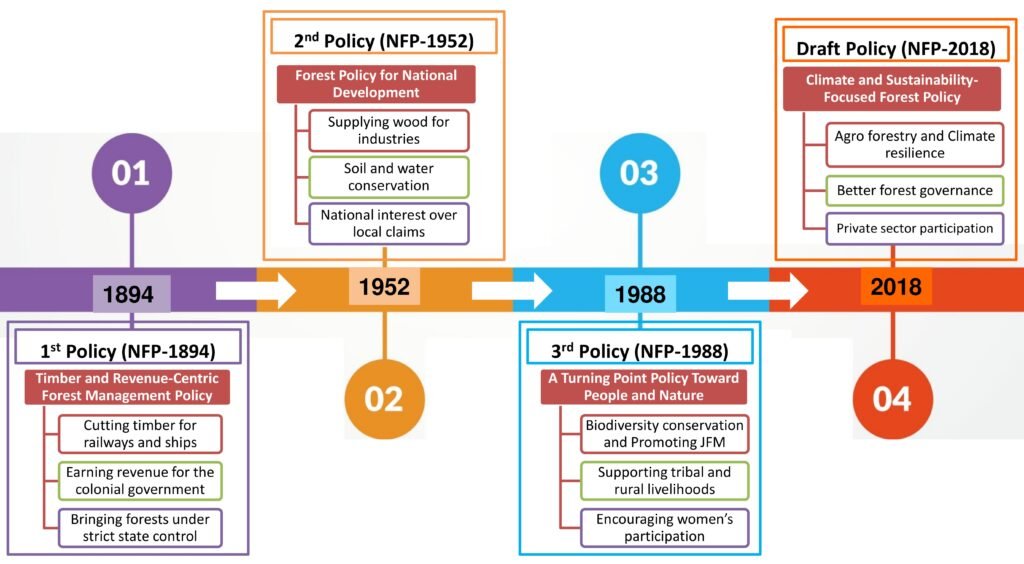
- Timeline graphic showing National Forest Policy evolution (1894–2018)
- NFP 1894: The Policy of Timber and Revenue-Centric Forest Management
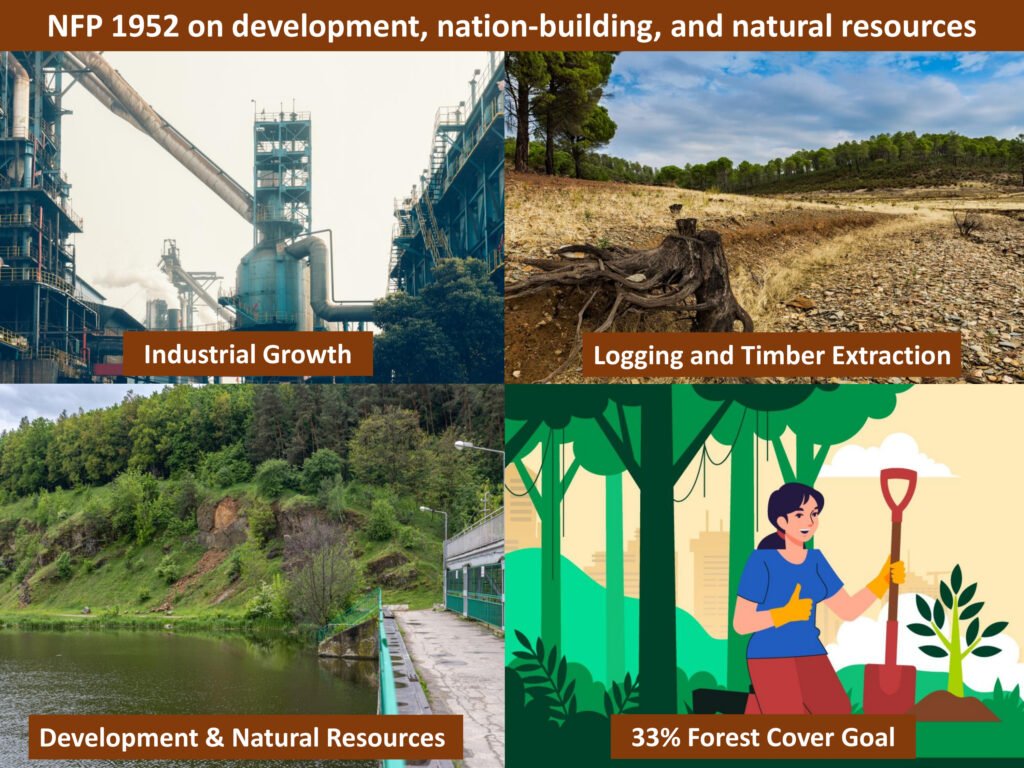
- NFP 1952: Forests as Engines of National Development
- NFP 1988: A Turning Point Policy Toward People and Nature
- NFP 2018 (Draft): Climate and Sustainability -Focused Forest Policy
- Why is NFP 2018 still a Draft?
Being a Forester, Forests have always meant something deeper to me.
They are not just trees. They are food, medicine, culture, rainfall, soil, wildlife, and the quiet strength of nature.

When we discuss forest policies in India, we are actually referring to how our country has understood and managed forests over time.
Let me take you on a simple journey of India’s forest policies from the colonial era’s timber extraction to today’s climate change discussions.
We can clearly see the shift from 1984 to 2018: Timber and revenue → national development → people and ecology → climate action.
I’ll explain everything in simple language.
Timeline graphic showing National Forest Policy evolution (1894–2018)
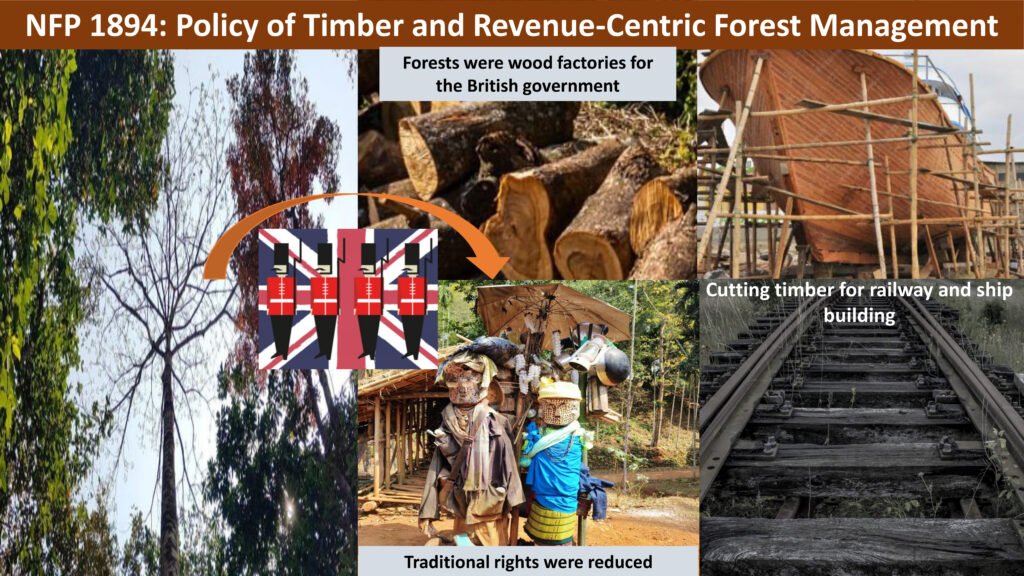
NFP 1894: The Policy of Timber and Revenue-Centric Forest Management
During British rule, forests were seen mainly as a source of money.
The 1894 forest policy focused on:
• Cutting timber for railways and ships
• Earning revenue for the colonial government
• Bringing forests under strict state control
Local communities, including tribal people, were not given priority. Their traditional rights were reduced. Forests were divided into categories, but the main goal was commercial use.
In simple words:
Forests were treated like wood factories during British rule.
This was the beginning of centralized forest control in India.
NFP 1952: Forests as Engines of National Development
After India became independent in 1947, the country needed development, roads, industries, housing, and agriculture. Post-independence India focused heavily on agriculture, dams, and infrastructure.
The 1952 forest policy tried to balance protection and production. But development was still the main goal.
It recommended 33% of India’s total land should be under forest cover: 60% in hilly areas and 20% in plains.
This was an important environmental target.
The policy also focused on:
• Supplying wood for industries
• Soil and water conservation
• National interest over local claims
In simple words:
Forests were now used for building the new India.
Even though conservation was mentioned, forests were still mainly seen as resources for economic growth.
NFP 1988: A Turning Point Policy Toward People and Nature
By the 1980s, India faced serious problems like deforestation, floods, soil erosion, shortage of fuel wood, and loss of biodiversity.
The 1988 forest policy changed everything.
For the first time, the main goal became:
Ecological stability and environmental protection.
This policy says forests are not just for timber; they are essential for life.
It focused on:
- Biodiversity conservation
- Meeting local needs (fuelwood, fodder, forest produce)
- Supporting tribal and rural livelihoods
- Encouraging women’s participation
- Promoting Joint Forest Management (JFM)
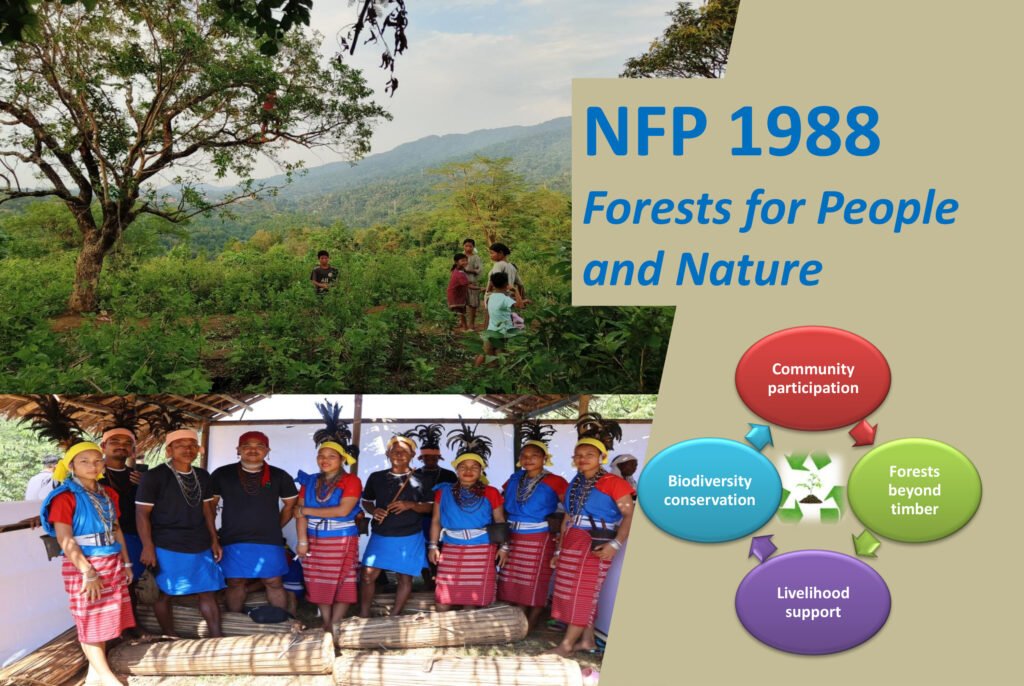
Communities were now seen as partners in protecting forests.
In simple words:
Forests were no longer just a source of revenue; they were for people and the planet. This policy is still regarded as one of the most significant in India’s environmental history.
Trending blog: What is Agroforestry-assisted Natural Farming? A Complete Guide
NFP 2018 (Draft): Climate and Sustainability -Focused Forest Policy
Today, the world is facing the challenge of climate change.
Now forests are important not only for biodiversity and livelihoods but also for carbon storage, climate change mitigation, and sustainable development.
The draft 2018 forest policy talks about:
• Climate resilience
• Carbon sequestration
• Agroforestry
• Better forest governance
• Private sector participation
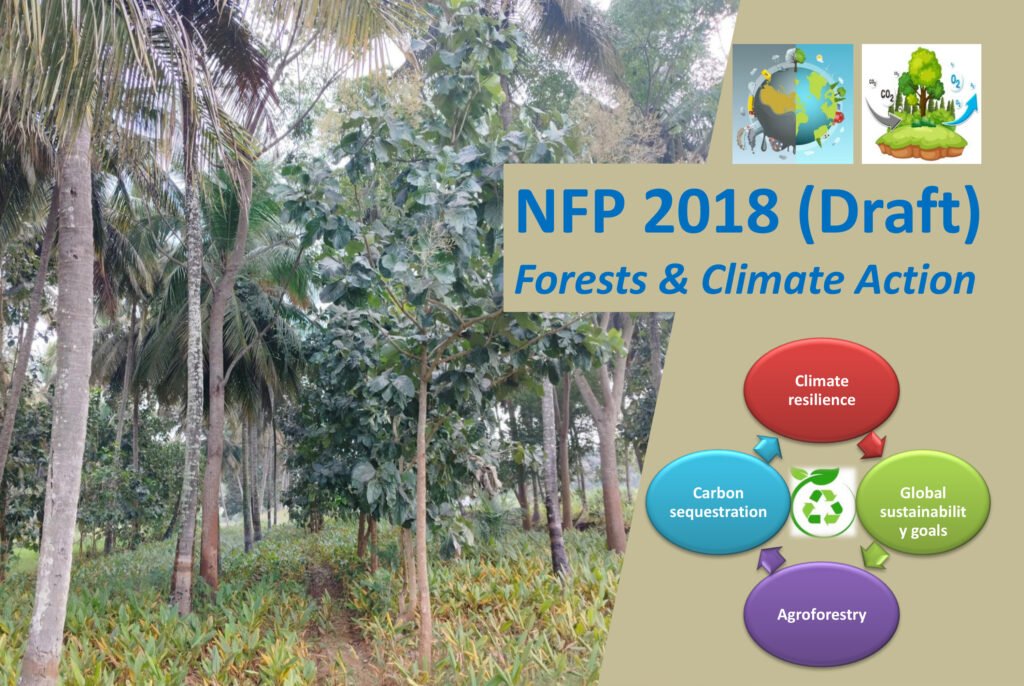
Forests are now connected to global climate agreements and sustainability goals.
In simple words:
Forests are now seen as powerful tools to fight climate change.
Why is NFP 2018 still a Draft?
NFP 2018 is still a draft because of the following reasons:
- It Was Only Released as a Draft: It was released only for public consultation and invited comments from states, experts, and civil society in 2018, and has not been formally approved.
- Strong Criticism from Civil Society: It faced criticism over concerns related to forest governance and community rights under the Forest Rights Act (FRA), 2006, and a shift in focus away from ecological protection toward commercial or plantation-oriented approaches.
- No Parliamentary Adoption Yet: Although a revised version (sometimes referred to as draft NFP 2019) was discussed at inter-ministerial meetings and reportedly sent to the Union Cabinet for decision-making, no final policy has been formally adopted or notified. Therefore, the NFP 1988 continues to remain in force.
Although this policy is still a draft, it shows the direction India is moving toward climate and sustainability goals.
What is Sub-Mission on Agroforestry? A Complete Guide

