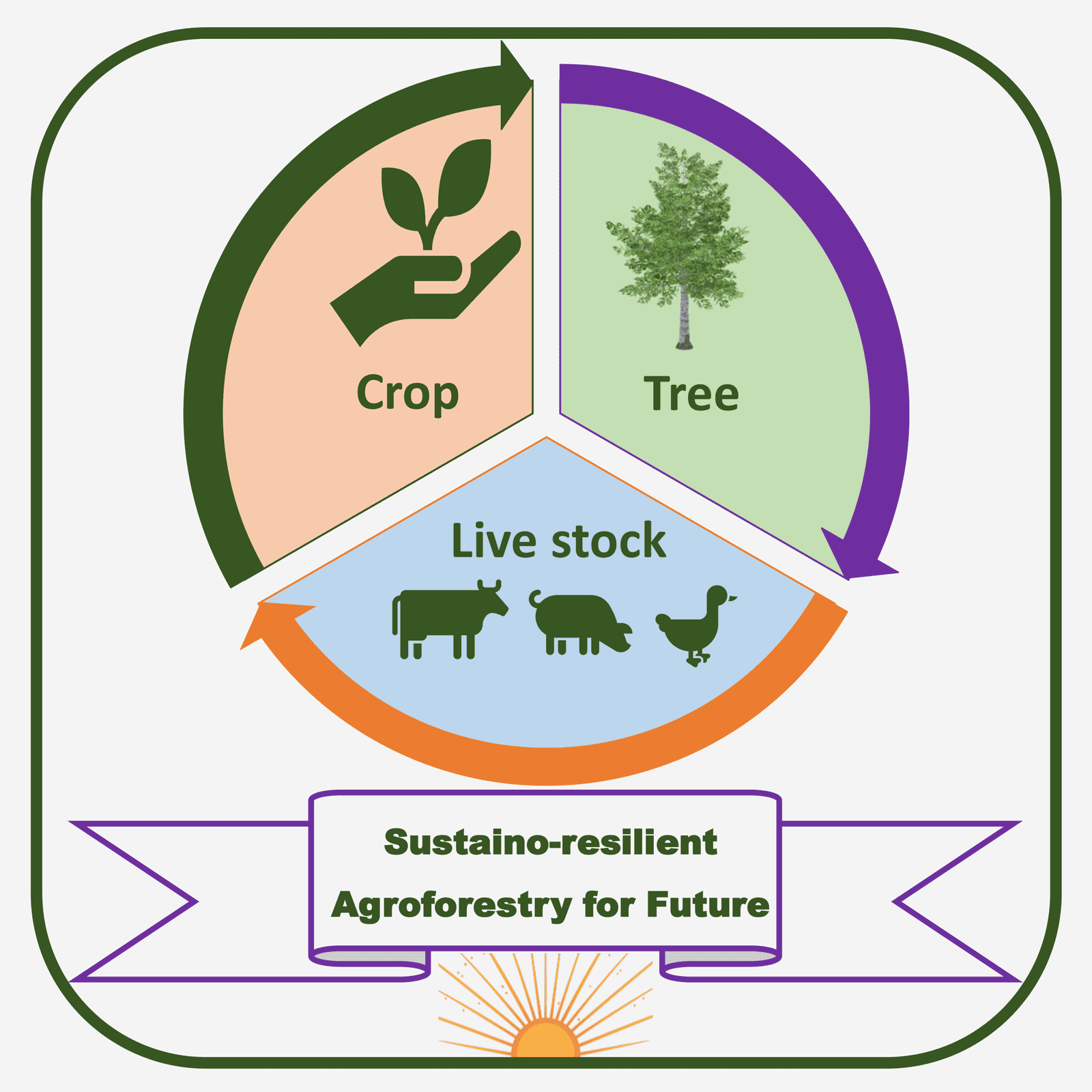
Agroforestry is a living system where annual crops grow alongside trees, sometimes joined by livestock. This intentional partnership of trees and crops shows how to live in harmony with nature. Trees send their roots deep into the soil, pulling up nutrients (nutrient pumping) and water; crops spread their roots wide, capturing what the trees leave behind. Leaves fall, microbes wake up, soil breathes again. Over time, the land remembers how to be fertile (closed nutrient cycling).
In these fields, agrobiodiversity flourishes. Birds nest in the branches, insects find shelter, and soil microorganisms get organic matter provided by trees. Carbon is stored in trunks, roots, and soils, turning farms into sustainable and climate-resilient. This simple partnership is a powerful response current challenges, like food security, land degradation, and climate change.
In India, agroforestry already covers about 28 million hectares, nearly 8.5% of the nation’s total geographical area. These tree-based systems hold close to 20% of India’s national carbon stocks, making them an invisible but vital climate buffer. Agroforestry supplies nearly 60–90% of the country’s domestic wood demand, supporting construction, energy, paper, and livelihoods. And yet, the story is unfinished.
Despite this immense contribution, India still imports nearly USD 7 billion worth of wood, with a CAGR of 15%. Considering this gap, the government has set a target to expand agroforestry to 50 million hectares by 2050. And also, to encourage agroforestry and trees outside the forest, the Centre for International Forestry Research–International Centre for Research in Agroforestry (CIFOR-ICRAF), in collaboration with the Indian Council of Agricultural Research (ICAR), hosted TREESCAPES-2026, the first South Asian Agroforestry & Trees Outside Forests Congress.
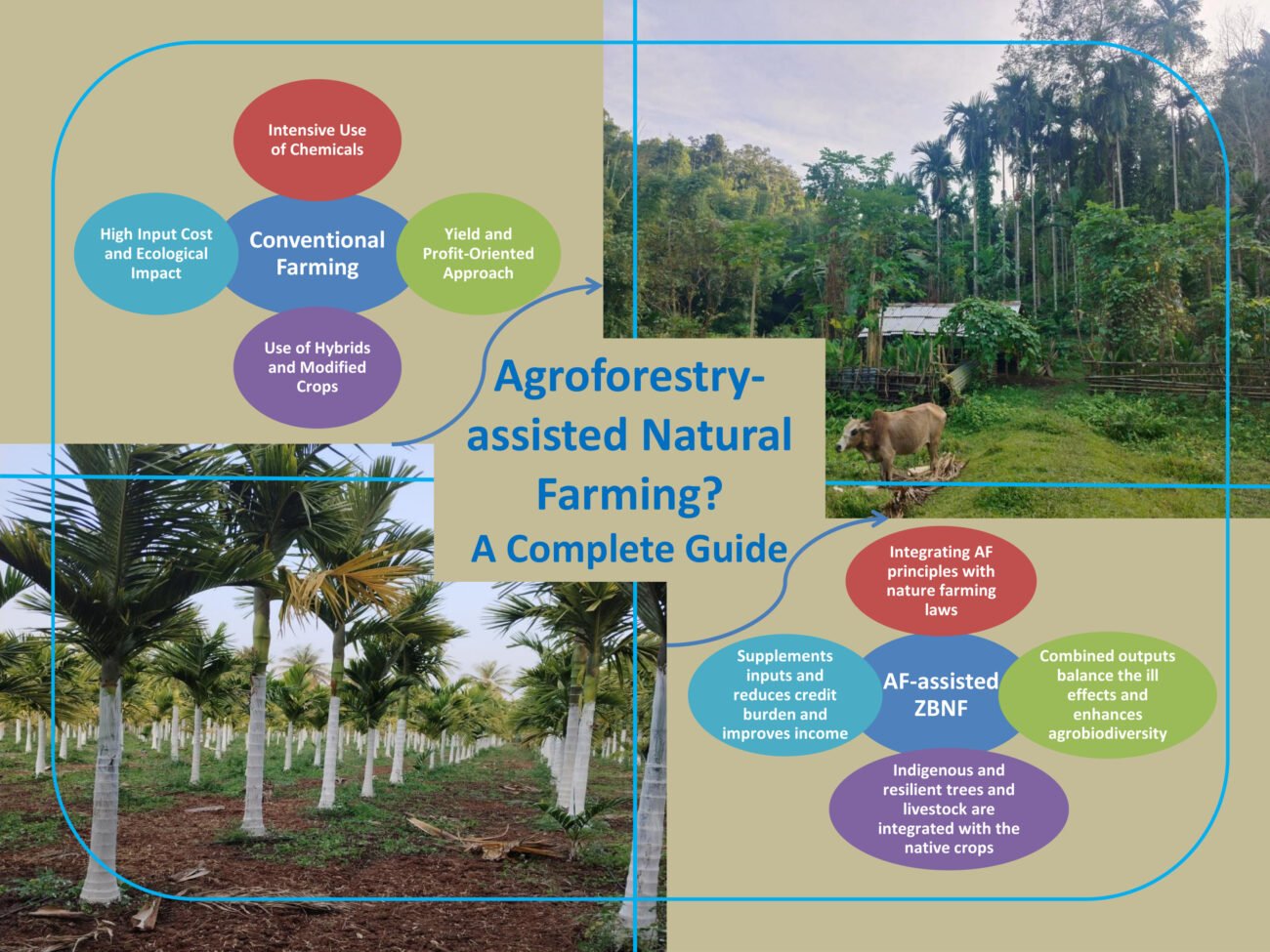
At the grassroots level, agroforestry-assisted Natural Farming offers a practical mechanism to translate these national goals into farm-level action. By integrating multipurpose trees with natural farming principles, agroforestry enhances on-farm biomass, improves soil microbial activity, and increases carbon sequestration. Importantly, tree components provide timber, fuelwood, fodder, and non-timber products, directly reducing pressure on forests and import dependence. Thus, AFNF emerges as a convergence point where climate action, farmer livelihoods, and national self-reliance in wood resources can be simultaneously achieved.
Trending blog: Click here
What is Agroforestry-assisted Natural Farming?
In Agroforestry-assisted natural farming, trees are the main component. Trees are integrated with annual crops and livestock, especially Desi cows. The principles of natural farming are used in Agroforestry. It is a natural way of farming that helps to rejuvenate soil, moisture, and crop health. Jivamrita, Bijamrita, mulching, soil aeration, intercropping, crop diversification, crop rotation, bunds, and bio-pesticides are utilized in a holistic approach.
Further reading: https://journalijecc.com/index.php/IJECC/article/view/1544
Principles of Agroforestry-assisted Natural Farming
- Nitrogen-fixing multipurpose trees as core components: Nitrogen-fixing and multipurpose tree species form the backbone of the system. These trees improve soil fertility, enhance biomass production, support biodiversity, and provide multiple outputs such as fodder, fuelwood, fruits, and timber.
- Complete avoidance of synthetic chemicals: The system strictly avoids the use of chemical fertilizers, pesticides, herbicides, and growth regulators. Crop nutrition and protection are managed entirely through natural and biological means.
- Use of natural bio-inputs: Indigenous bio-inputs such as Jeevamrita and Bijamrita are used to enhance soil microbial activity and seed health. Mulching and botanical biopesticides help conserve soil moisture, suppress weeds, and manage pests naturally.
- Focus on annual crops and shade-tolerant species in initial years: During the first 4-5 years, emphasis is placed on cultivating annual crops, shade-loving plants, and cover crops. This ensures regular income for farmers while improving soil structure and ecosystem stability as trees establish.
- No Tillage/Minimal Tillage: This prevents soil disturbance, allowing earthworms and microorganisms to thrive.
- Natural Pest Control: Botanical extracts like Dashparni ark and Neem Astra are used, alongside techniques like using salt for mango shoot borer. prepared on the farm using locally available materials, ensuring low-cost and sustainable production.
- Soil Management: Soil is kept covered with organic mulch (straw, crop residue) to regulate temperature, retain moisture, and create humus.
Components of Agroforestry-assisted Natural Farming
- Tree component: Tree planting helps to create amiable habitats and have positive impact on the health of our native, associated flora and fauna. Also, good controller of CO2 emissions, and improve microclimate of an area. The Trees can communicate and defend themselves against attacking insects and pests through their chemicals and signal danger to other trees to start their own defense. Planting fruit trees aids in food and nutritional security, reduces the greenhouse effect, and slows the rate of global warming. Dietary diversity has antioxidants, vitamins, minerals, fibers, etc., and helps to protect from various infections and diseases. Tree by-products have good medicinal applications and are used in the treatment of various ailments. The leaf litter produced by the trees is rich in allelochemicals, which often imparts species resistance to insects and pathogens. In addition, AF has diverse components that act as biological barriers for the insect and pests. Some AF multipurpose tree species are used in bio-pesticides.
- Livestock component: Livestock includes rearing of animals like cattle, buffalo, sheep, pigs, goats, horses, mules, asses, and camels, as well as rearing of birds such as chickens, ducks, and fowl, etc. Livestock supply high-quality meat protein, milk, foodstuffs, etc., and by-products such as dung, urine, hide, etc. Indigenous livestock-based AF systems can provide a great opportunity for improving food security, along with meeting various tangible and intangible needs of all forms. A study recommended indigenous livestock-based AF systems to enhance sustainability and/or resilience, along with positive economic and ecological benefits in different AF systems. In addition i, it also lessens the gap between production and consumption, and the inability of supplies to meet the projected demand of animal-based food and other outputs. The livestock helps in land preparation, transportation, and energy source, and provides by-products like dung and urine, which enhance soil fertility, nutrient cycling, crop growth, and productivity. Integrating livestock with shade-providing and protein-rich multipurpose trees improves animal performance, productivity, and other ecosystem services.
- Crop component: Crops from agriculture, horticulture, and medicinal plants, including annual and perennial crops, can be incorporated to improve the yield, and soil physicochemical and biological properties.
Advantages of Agroforestry-assisted Natural Farming
- Increased Timber Availability: In Agroforestry-assisted natural farming, trees are a central component of the farming system. Planting nitrogen-fixing, multipurpose, native tree species on field bunds, boundaries, and within farms increases timber and fuelwood availability. Trees Outside Forests (TOF) reduces dependence on timber imports and minimizes pressure on natural forests. Such systems directly contribute to national targets of 50 million hactares area under agroforestry by 20250.
- Enhanced Biodiversity: The integration of trees, crops, livestock (especially Desi cow–based systems), and soil microorganisms creates a living ecosystem. Diverse tree species provide shelter for birds, beneficial insects, pollinators, and microbes. This biodiversity ensures natural pest control, ecological balance, and resilience of the farming system.
- Year-Round Income and Employment: Agroforestry-assisted natural farming promotes multi-layer and multi-storey cropping systems, where trees, shrubs, climbers, annual crops, and livestock coexist. Returns are obtained at different intervals, daily (milk), seasonal (crops, vegetables), and long-term (timber, fruits). This ensures year-round income, continuous on-farm employment, and reduced dependence on single crops. It protects farmers from climate change shocks.
- Food and Nutritional Security: Agroforestry-assisted natural farming produces a wide range of foods such as fruits, nuts, vegetables, grains, milk, and meat. Tree-based foods are rich in micronutrients, antioxidants, and medicinal properties. This diversity improves household food security, dietary diversity, and nutritional well-being, especially for small and marginal farmers.
- Protection from Indebtedness: A core principle of natural farming is the elimination of the use of purchased inputs. Practices such as Jeevamrutha, Beejamrutha, Mulching (Acchadana), and Waaphasa drastically reduce the cost of cultivation. Agroforestry further diversifies income and enables access to green finance, ecosystem service payments, and carbon markets, protecting farmers from debt and financial vulnerability.
- Climate Resilience, Carbon Sequestration, and Soil Health: Trees play a crucial role in enhancing carbon sequestration and climate resilience in agroforestry-assisted natural farming systems. Canopy cover moderates temperature, reduces evapotranspiration, and protects crops from extreme weather. Deep-rooted trees improve soil structure, increase soil organic carbon, enhance moisture retention (Waaphasa), and stimulate microbial activity, leading to long-term soil fertility and sustainable productivity.
Major constraints in Agroforestry-assisted Natural Farming
- Limited Availability of Quality Planting Material: One of the foremost constraints in agroforestry-assisted natural farming is the non-availability of quality planting materials (QPM) such as certified seedlings of fruit trees, timber species, multipurpose trees, and indigenous species. Most nurseries focus on a limited number of commercial species, while region-specific, climate-resilient, and native tree species are often unavailable.
- Long Gestation Period of Tree Components: Agroforestry systems involve perennial tree species that require several years to start yielding economic returns. This long gestation period discourages farmers, especially small and marginal farmers, who depend on short-term income for livelihood security. The delayed benefits from trees often make agroforestry-assisted natural farming less attractive compared to annual crop-based systems.
- Small and Fragmented Land Holdings: The predominance of small and marginal landholdings poses a major limitation to the adoption of agroforestry-assisted natural farming. Farmers are often reluctant to allocate scarce land to trees due to the fear of competition with food crops, shading effects, and a reduction in cultivable area. Fragmented land parcels further restrict the systematic layout and scientific integration of trees, crops, and livestock.
- Lack of Standardized Package of Practices (PoP): There is a lack of location-specific and scientifically validated packages of practices for agroforestry-assisted natural farming systems. Information on suitable tree-crop combinations, spacing, pruning, nutrient management using natural inputs, and pest–disease management is limited. The absence of clear operational guidelines creates confusion among farmers and extension workers, hindering large-scale adoption.
- Absence of Demonstration Models and Proven Success Stories: The lack of well-documented success stories and field-level demonstrations from research institutions and universities is another critical constraint. Farmers are more likely to adopt innovations when they see visible economic and ecological benefits in real farming situations.
Conclusion
Agroforestry-assisted natural farming has immense potential to emerge as a sustainable, climate-resilient, and economically viable farming system by improving soil health, enhancing farm income, strengthening biodiversity, and reducing the country’s dependence on imported wood and wood-based products. However, the successful scaling of this system cannot be achieved in isolation. It requires collective and coordinated efforts among policymakers, farmers, private agencies, and research institutions.
Further reading: https://journalijecc.com/index.php/IJECC/article/view/1544
What is Sub-Mission on Agroforestry? A Complete Guide

