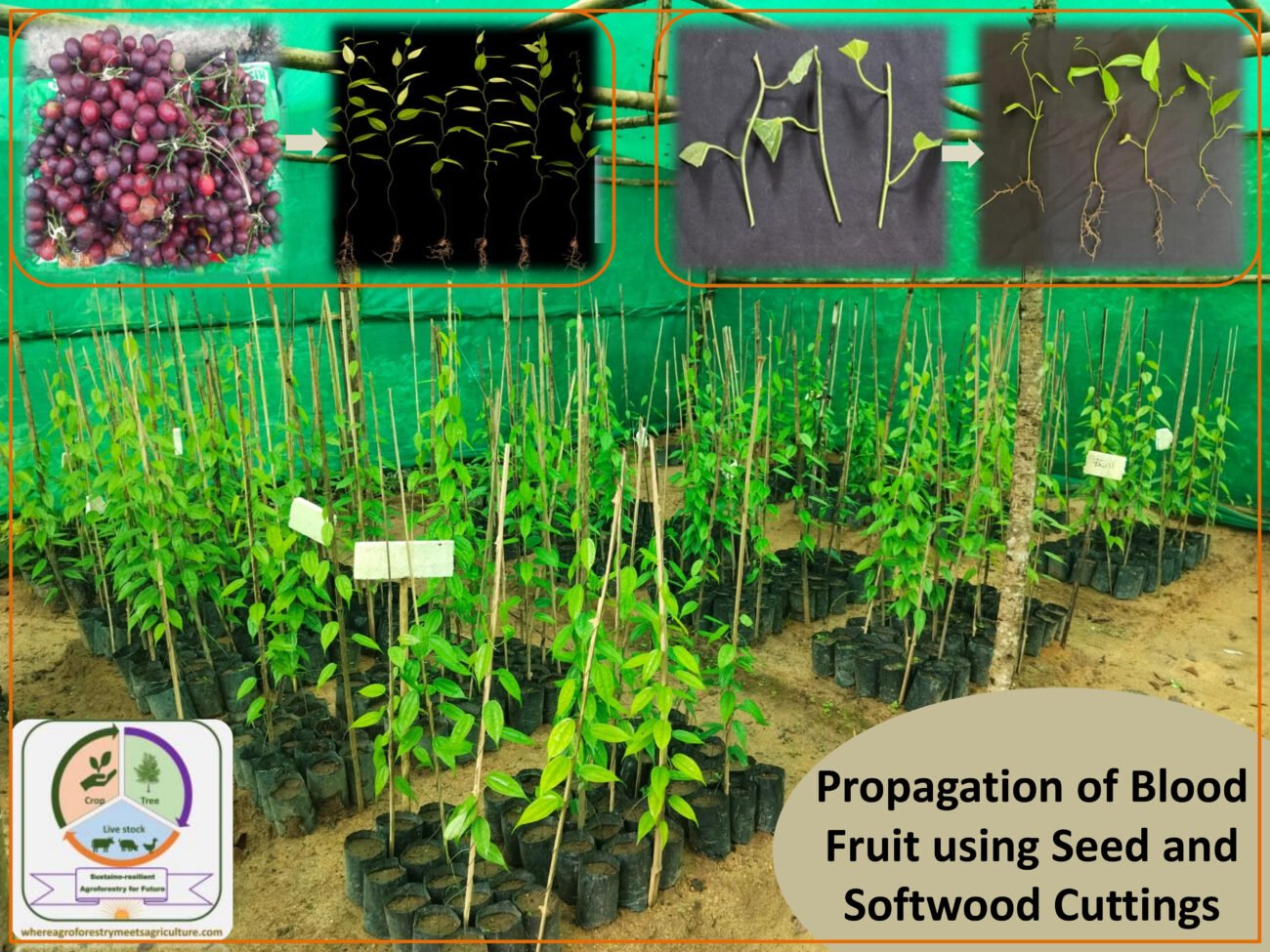
Blood fruit (Haematocarpus validus), commonly known as Khoon phal, is a wild climber that originates from Southeast Asia. The Fruits are rich in antioxidants, iron, Vitamin C, β-carotene, phenols, flavonoids, and anthocyanins. In India, this climber can be found in the Andaman and Nicobar Islands and the North-Eastern region. In the North-Eastern region, the Garo Hills region of Meghalaya is home to this unique wild edible fruiting climber. The Garo Hills are inhabited by a community called the Garo (A.chik Mande means Hill People) uses this fruit for medicinal and culinary purposes. The fruits are high in demand in the local markets of Garo Hills; a single bunch of fruit costs around Rs. 100/-. The flowering starts from October, and the fruits are sold in the local market from March to May. However, this unique, underutilized climber is in urgent need of survival.
Further Reading: Harnessing the underutilized blood fruit through forest-to-farm transition
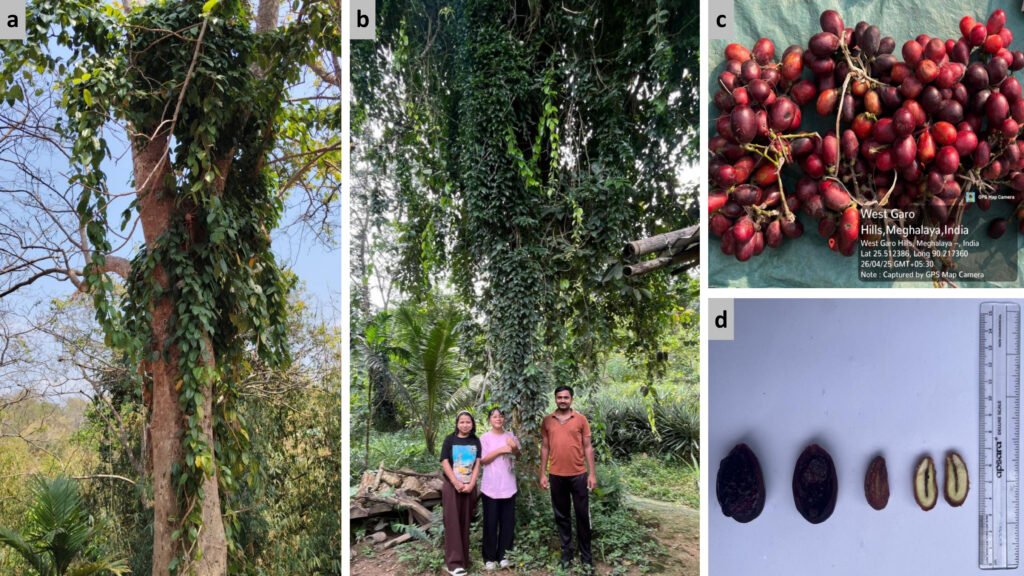
Many intrinsic and extrinsic factors contribute to irregular, slow germination and delayed natural emergence. The intrinsic factors, such as the presence of male and female flowers in different plants (diecious nature), recalcitrant seeds, and underdeveloped embryos, remain a major challenge associated with seed-based propagation. The extrinsic factors, such as habitat destruction, unsustainable harvesting, and climate change, further threaten natural populations and limit regeneration potential. Under such conditions, the development of robust, high-quality planting material becomes essential for conservation and large-scale cultivation.
Our recent study, entitled “Integrated propagation strategies for the conservation and commercialization of Blood Fruit (Haematocarpus validus Miers)” from the Garo Hills, Meghalaya, tested simple nursery methods that farmers can use for mass multiplication and cultivation.
Where and How the Study Was Done
The study was carried out under nursery conditions similar to what farmers can create:
- Climate: Moderate (12–34 °C)
- Shade: 50% shade net (can use agro-shade or natural shade)
- Growing medium (for better root growth and healthy seedling production):
Soil + FYM + Vermicompost (2:1:1)
1. Propagation Steps Using Seeds
1.1. Seed Collection
- Collect fully ripe fruits from healthy plants during March to May
- Remove pulp and wash seeds properly
Note: Cleaning (depulping) is important to avoid fungal problems.
1.2. Seed Treatment
For better germination, farmers can follow these easy methods:
- The best and simplest method is to soak the seeds in water for 24 hours
- Optional (technically advanced):
- GA₃ (500 ppm) for faster germination
- Thiourea (0.1%) for better seedling growth
Note: Before sowing, dip seeds in 0.2% Bavistin to reduce fungal infection (observed up to 85% reuduction) and improve seed survival in the nursery.
1.3. Sowing
- Sow seeds at 1 cm depth
- Keep soil moist (not waterlogged)
- Maintain partial shade
1.4. Staking for Healthy Growth
- Around one month after germination, when the plumule emerges, provide support.
- Use split bamboo sticks (thin and about 1 m long) for staking.
- Place the bamboo sticks gently near each seedling. Helps upright growth, prevents damage, and promotes vigorous development.
1.5. Outplanting with Support
- Transplant seedlings three months after sowing (roughly two-month-old seedlings with growth of more than 1 m in length).
- Maintain proper spacing in the field.
- Provide staking or live support at planting time.
- This helps with quick establishment and prevents bending or breakage.
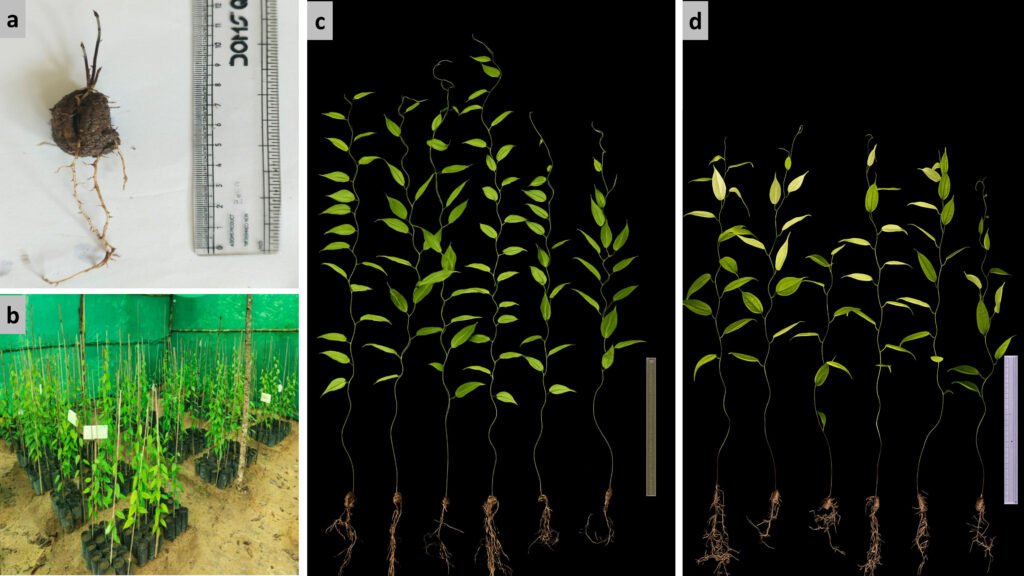
2. Propagation Steps Using Softwood Cuttings
The seed method is simple, but softwood cuttings can produce faster, more uniform plants. In our study, softwood cuttings also showed very good success
2.1. Select Suitable Cuttings
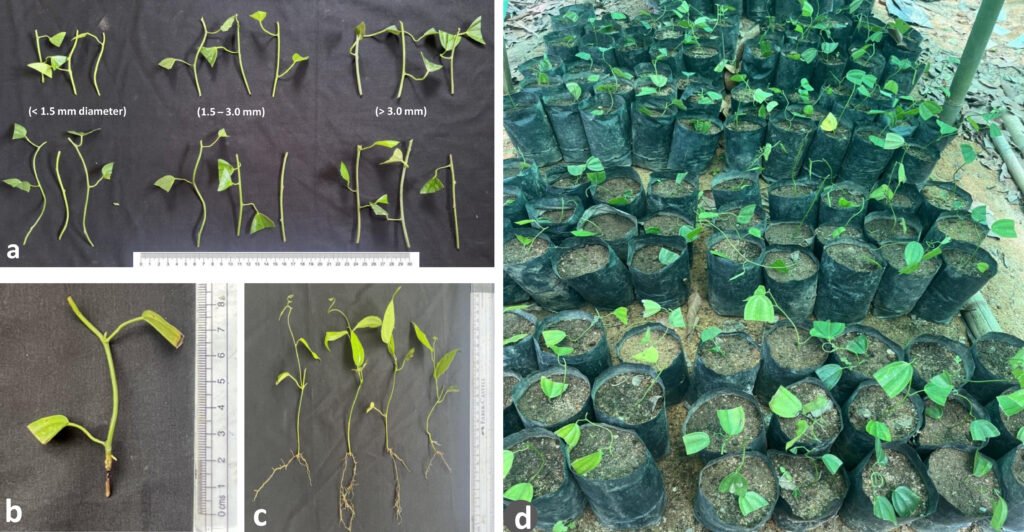
Select thin (< 1.5 mm) softwood cuttings from healthy, disease-free mother plants before flowering stage (preferably September).
Note: Cutting thickness affects rooting success.
2.2. Decide Number of Nodes
Each cutting should have two numbers of nodes (See figure 3. a).
Note: Two nodes can improve survival and reduce water loss.
2.3. Prepare Growth Regulator Treatments
To enhance rooting, prepare auxin (plant hormone) treatment: Naphthalene acetic acid (NAA) at a 500 ppm concentration
Note: This step is optional, as it is technically advanced
2.3.1. How to Prepare NAA 500 ppm in Talc Powder (Dry Method)?
- Take 0.5 gram (500 mg) of NAA
- Add 5–10 ml alcohol (spirit) to NAA (this helps uniform mixing in the talk powder)
- Mix until it becomes a clear solution
- Take 1 kg of talc powder
- Slowly pour the NAA solution over it
- Mix thoroughly until the powder becomes uniform (no lumps)
- Spread the mixture in the shade (Do not dry in direct sunlight)
- Allow alcohol to evaporate completely
Note: Use gloves while mixing, store in an airtight container, and keep in a cool and dry place.
2.3.2. How to Use (Quick Dip – Dry Method)
- Slightly moisten the basal end of the cuttings
- Dip into the prepared NAA powder
- Tap gently to remove excess powder
- Plant immediately in the polybag containing growing medium Soil + FYM + Vermicompost (2:1:1) under nursery conditions
2.4. Covering and Ventilation
- Cover the cuttings with transparent polythene immediately after planting.
- Maintain the cover for up to 7 days to retain humidity.
- Provide brief ventilation on alternate days for air exchange.
- Continue until rooting begins or new leaves emerge.
2.5. Intercultural Operations
- Water regularly to maintain adequate moisture.
- Provide partial shading to protect from direct sunlight.
- Monitor for rooting and new growth.
- Protect cuttings from pests and diseases through proper care.
Further Reading: Integrated propagation strategies for the conservation and commercialization of Blood Fruit
3. Comparison of Seed-Based and Softwood Cutting Propagation Methods
| Propagation Method | Advantages | Disadvantages |
| Seed-based | 1. Maintains genetic diversity 2. Suitable for large-scale plantation 3. Farmer-friendly (e.g., water soaking achieves up to ~95% germination) 4. Useful for conservation and degraded lands | 1. Slow and irregular germination of seeds 2. Dormancy issues 3. Fruits are costly 3. Longer time for establishment (Three months) 4. Less uniform growth |
| Softwood Cuttings | 1. Rapid multiplication (Shoot and root initiate within 15 days) 2. Uniform and true-to-type plants 3. Faster establishment (Two months) 4. High success with NAA (500 ppm) | 1. Requires technical skill 2. Limited genetic diversity 3. Requires quality mother plants 4. Needs hormone treatment |
4. Final Takeaway
- Both methods are effective, but serve different purposes.
- Use seed propagation for conservation and large-scale planting.
- Use cuttings for quick and uniform multiplication of superior plants.
- Practices like 24-hour water soaking and NAA 500 ppm treatment can greatly improve success.
- Application of Bavistin treatment and selection of a suitable nursery mix help further.
The best approach is a combined strategy: maintaining diversity with seeds and multiplying elite plants through softwood cuttings.
Explore the full research publication and detailed results: Integrated propagation strategies for the conservation and commercialization of Blood Fruit (Haematocarpus validus Miers)
Wild Edible Plants of Garo Hills, Meghalaya: A Latest Research


Blood fruit grafting plant available hai ?
Yes! Six month old grafted Blood fruit plants are available. Contact Dr. Dinesha S. Ph: 9382369342