- What is RKVY Agroforestry?
- Why Agroforestry under RKVY is Important?
- Policy Background: From National Agroforestry Policy to RKVY
- Objectives of RKVY Agroforestry
- Quality Planting Material (QPM): The Core Focus
- ICAR-CAFRI: Nodal Agency for Agroforestry
- Role of State Governments and Nodal Agencies
- Distribution of Planting Material and Farmer Support
- Digital Monitoring, Geo-Tagging, and Technology Use
- Convergence with MNREGA: Strengthening Implementation
- Financial Support and Interventions under RKVY Agroforestry
- Expected Outcomes of RKVY Agroforestry
- RKVY Agroforestry: The Way Forward
- Frequently Asked Questions (FAQs)
- What is RKVY Agroforestry?
- How is RKVY Agroforestry different from the Sub-Mission on Agroforestry (SMAF)?
- Who is eligible to benefit from RKVY Agroforestry?
- What is Quality Planting Material (QPM) in agroforestry?
- Who certifies Quality Planting Material under RKVY Agroforestry?
- Is RKVY Agroforestry linked with MNREGA?
In India, Agroforestry has emerged as one of the most promising solutions for climate-resilient agriculture. Recognising its potential to improve farm income, enhance soil fertility, and reduce pressure on forests, the Government of India has integrated agroforestry as a key component of the Rashtriya Krishi Vikas Yojana (RKVY) as RKVY Agroforestry.
The RKVY Agroforestry component operationalises the vision of the National Agroforestry Policy-2014, by focusing on quality planting material (QPM), institutional support, market linkages, and convergence with flagship rural development programmes like MGNREGA.
This blog explains what RKVY Agroforestry is, why it matters, how it works, and what opportunities it creates for farmers, researchers, startups, and states.
What is RKVY Agroforestry?
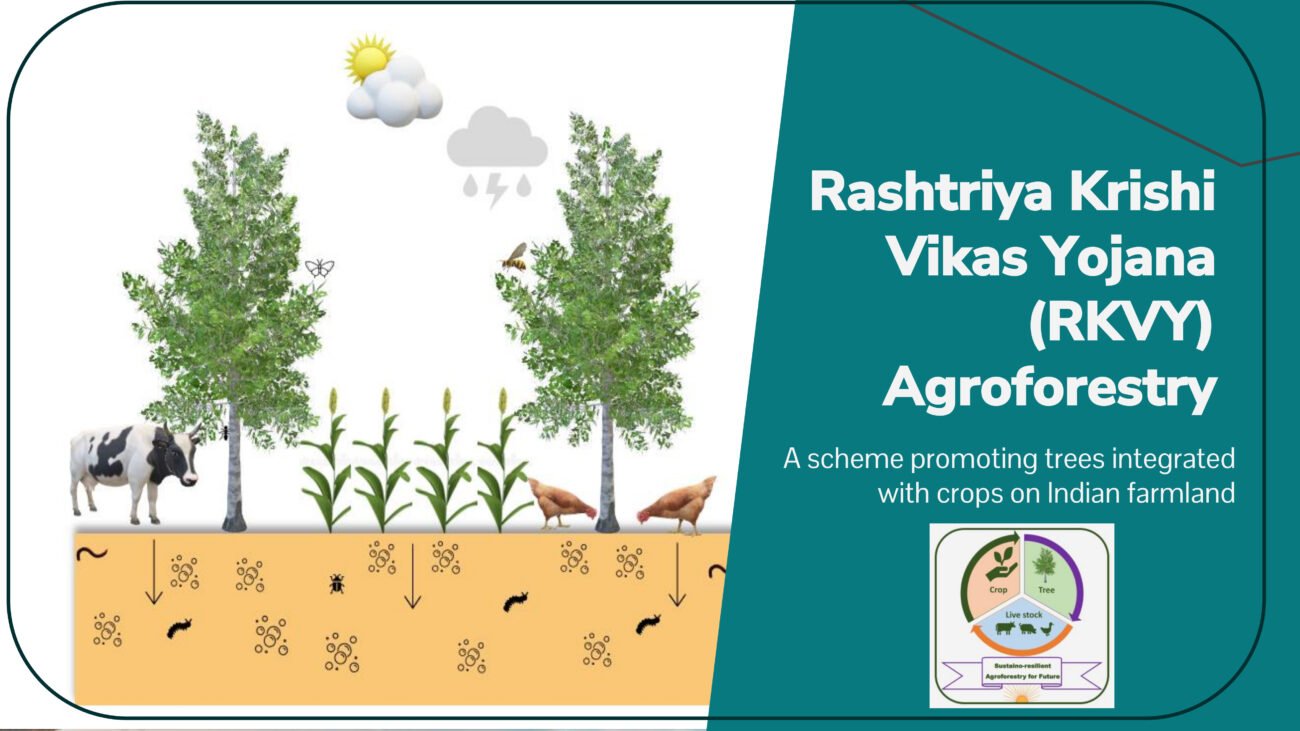
Rashtriya Krishi Vikas Yojana (RKVY) is a flagship scheme of the Ministry of Agriculture & Farmers’ Welfare aimed at strengthening agricultural development through state-led planning and investment. Under RKVY, Agroforestry is promoted as an integrated land-use system where trees are grown alongside crops and/or livestock, ensuring both ecological stability and economic returns. The scheme follows the general provisions of RKVY while adopting the technical and strategic framework of the Sub-Mission on Agroforestry (SMAF) under the National Mission for Sustainable Agriculture (NMSA).
Why Agroforestry under RKVY is Important?
Indian agriculture is increasingly vulnerable to:
- Climate change and extreme weather events
- Land degradation and declining soil fertility
- Income instability among small and marginal farmers
- Rising demand for timber, fuelwood, and non-timber forest products
- Agroforestry addresses these challenges by:
- Moderating microclimate and conserving soil moisture
- Improving nutrient cycling and soil organic carbon
- Diversifying farm income through tree-based products
- Enhancing resilience to droughts, floods, and heat stress
Policy Background: From National Agroforestry Policy to RKVY
The National Agroforestry Policy (2014) laid the foundation by:
- Recognising agroforestry as a distinct land-use system
- Recommending institutional mechanisms and financial support
- Emphasising quality planting material and market access
- To translate this policy vision into action:
Sub-Mission on Agroforestry (SMAF) was launched in 2016–17
Agroforestry was strengthened through RKVY funding and state action plans
The guiding principle remains “Har Med Par Ped”- trees on every farm bund.
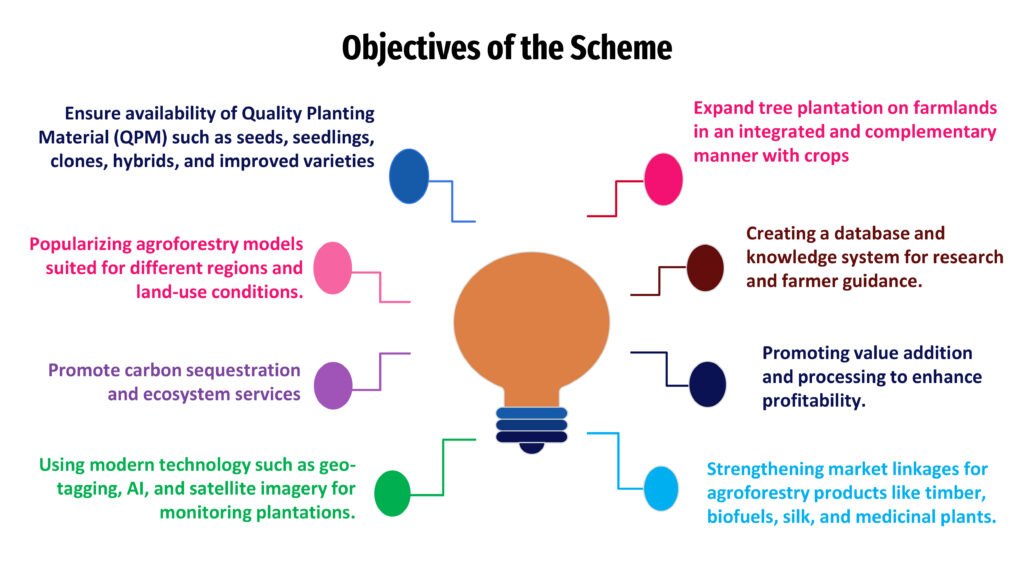
Objectives of RKVY Agroforestry
Quality Planting Material (QPM): The Core Focus
A major constraint in agroforestry adoption has been the lack of certified, high-quality planting material. Although most nurseries in India are privately owned, only a small proportion currently supply true QPM.
Under RKVY Agroforestry:
- QPM includes healthy, resilient, and adaptable nursery stock
- It is treated as part of a value chain, starting from seed source to final product
- Quality at the seed stage determines long-term productivity, survival, and profitability
ICAR-CAFRI: Nodal Agency for Agroforestry
The ICAR–Central Agroforestry Research Institute (CAFRI) serves as the national nodal agency for technical guidance and certification under RKVY Agroforestry.
Key roles include:
- Developing standards for nursery registration, accreditation, and certification
- Supporting QPM production through AICRP centres
- Training master trainers and capacity-building institutions
- Coordinating with ICFRE, CIFOR–ICRAF, CSIR, SAUs, CAUs, private partners, and others
- Acting as a national repository of agroforestry knowledge
Role of State Governments and Nodal Agencies
Each State/UT identifies a State Nodal Department/Agency, responsible for:
- Implementing the agroforestry action plan under RKVY
- Producing or sourcing QPM through collaborations with KVKs, FPOs, NGOs, SAUs, entrepreneurs, and farmers
- Ensuring physical verification and certification of nurseries
- Conducting training, demonstrations, and extension activities
State Forest Departments play a crucial role as custodians of seed and germplasm.
Distribution of Planting Material and Farmer Support
- QPM is provided free of cost or at subsidised rates
- Farmers carry out plantation and maintenance
- Plantation and maintenance costs are met through convergence with MNREGA and other schemes
- This convergence reduces financial burden on farmers and ensures long-term survival of plantations
Digital Monitoring, Geo-Tagging, and Technology Use
RKVY Agroforestry strongly emphasises technology-driven monitoring:
- Geo-tagging of all land-based interventions
- Use of mobile apps such as Farm Tree (ICAR-CAFRI) and Agroforestry App Odisha (ICRAF)
- Development of a national agroforestry web portal
- GIS, satellite imagery, AI, and ML-based monitoring with MNCFC and ICAR
This ensures transparency, accountability, and real-time impact assessment.
Convergence with MNREGA: Strengthening Implementation
Agroforestry under RKVY is closely converged with MNREGA, where a major share of expenditure is earmarked for agriculture and allied activities.
MNREGA supports:
- Nursery raising
- Boundary, block, and farm forestry plantations
- Silvipasture and wasteland development
- Maintenance and survival of plantations
This convergence transforms agroforestry into a people-centric, employment-generating programme.
Financial Support and Interventions under RKVY Agroforestry
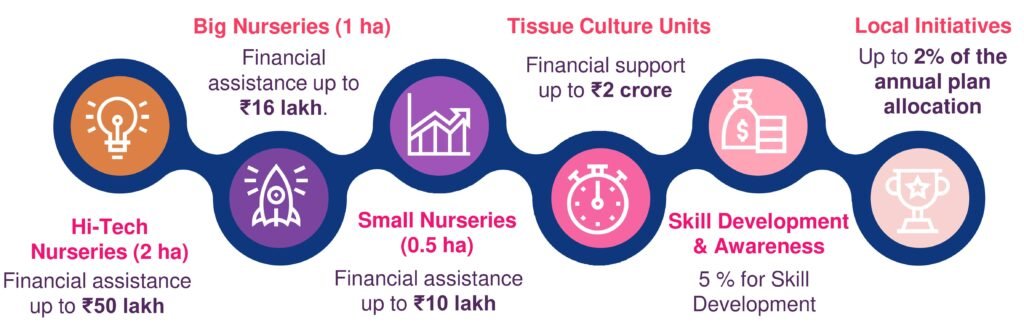
Government agencies receive 100% assistance, while private entities receive 50% credit-linked support, encouraging entrepreneurship in agroforestry.
Expected Outcomes of RKVY Agroforestry
- Sustainable supply of Quality Planting Material
- Increased tree cover on farmlands and community lands
- Reduced pressure on natural forests and lower timber imports
- Additional and stable income for farmers
- Enhanced carbon sequestration and ecosystem services
- Improved resilience of Indian agriculture to climate change
RKVY Agroforestry: The Way Forward
RKVY Agroforestry represents a shift from input-driven agriculture to system-based land management. By integrating trees, crops, livelihoods, and technology, it creates a pathway where productivity, sustainability, and farmer prosperity coexist.
As India moves towards climate-smart agriculture and green growth, agroforestry under RKVY stands out as a practical, scalable, and inclusive solution.
Frequently Asked Questions (FAQs)
What is RKVY Agroforestry?
RKVY Agroforestry is a component of the Rashtriya Krishi Vikas Yojana (RKVY) that promotes tree-based farming systems on agricultural land. It integrates crops, trees, and sometimes livestock to improve farm income, soil health, and climate resilience, in line with the National Agroforestry Policy (2014).
How is RKVY Agroforestry different from the Sub-Mission on Agroforestry (SMAF)?
While SMAF provides the technical and strategic framework under the National Mission for Sustainable Agriculture (NMSA), RKVY Agroforestry supports implementation through state-led planning, funding, and innovation. RKVY offers flexibility for states to design region-specific agroforestry models.
Who is eligible to benefit from RKVY Agroforestry?
Farmers, farmer groups, FPOs, Self Help Groups (SHGs), NGOs, startups, research institutions, and state agencies are eligible. Farmers receive Quality Planting Material (QPM) and support for plantation and maintenance, often through convergence with MNREGA.
What is Quality Planting Material (QPM) in agroforestry?
Quality Planting Material refers to certified, healthy, genetically superior seeds, seedlings, clones, hybrids, or tissue culture plants. Under RKVY Agroforestry, QPM ensures better survival, faster growth, higher productivity, and long-term profitability of agroforestry systems.
Who certifies Quality Planting Material under RKVY Agroforestry?
The ICAR–Central Agroforestry Research Institute (ICAR-CAFRI) acts as the national nodal agency. It develops standards for nursery registration, accreditation, and certification and provides technical guidance to states and implementing agencies.
Is RKVY Agroforestry linked with MNREGA?
Yes. RKVY Agroforestry is strongly converged with MNREGA. MNREGA supports labour-intensive activities such as nursery raising, plantation, boundary and block plantations, silvipasture development, and maintenance of agroforestry plantations.
For Further Reading: OPERATIONAL GUIDELINES-AGROFORESTRYUNDER RASHTRIYA KRISHI VIKAS YOJANA (RKVY


Leave a Reply