After being in the Northeast for three years, I have observed frequent water scarcity in one of the wettest regions in the world.
I see a similar paradox when I think about Teak and Sal in India.
India has a long history of teak and sal cultivation, extensive silvicultural knowledge, suitable growing regions, and strong domestic demand for teak and sal.
Yet, despite all this, India continues to depend heavily on imports.
In the present scenario, where researchers are not getting enough funding to conduct research, it makes me to write my perception when a few state governments focus on forestry or agroforestry promotion.
This story started when I read about Karnataka’s second species-specific Tega Siri Scheme, after Siri Chandana.
After reading about it, I also remembered other states’ efforts to conserve and commercialize a few key trees.
But few questions comes in my mind,,,
- Is encouraging farmers to grow teak a good opportunity?
- What are the potential benefits?
- What are the concerns?
- Can such a scheme help address India’s long-term teak supply needs?
- More importantly, can farmers actually benefit from growing a long-rotation timber crop?
Why Does Teak Fascinate Me as a Forester?
Being a forester, most of us have read about how teak farming was initiated during the colonial period.
After reading some ancient forest literature, I felt like India had forest experts and considerable knowledge of forests and natural resources for Centuries.
So, when did scientific forestry really begin?
Anyway, when we talk about scientific forestry during the colonial period, teak and sal immediately come to mind.
As we read in much of the forestry literature, teak was extremely valuable to the Europeans (British), particularly for shipbuilding.
Napoleon Bonaparte is often credited with observing that the British were strong at sea while he was strong on land, but ultimately, control of the seas played a crucial role in his defeat.
This gives some hints about why teak was so important to the British. A strong navy required strong ships, and strong ships required durable timber. Indian teak became one of the valuable resources that supported this maritime power.
Its strength, durability, and natural resistance to decay made it an important timber for ships at a time when the British Empire was expanding its naval power.
Sal, on the other hand, became particularly important with the expansion of the Indian railway network, where its strong and durable timber was widely used for railway sleepers.
British first exploited India’s teak.
Then they restricted Indians from harvesting it.
But later they went one step further: they started systematically managing teak forests and laid the foundation for scientific forestry in India during the colonial period.
H. V. Conolly, the District Collector of Malabar under the Madras Presidency, played an important role in establishing the historic teak plantation at Nilambur, Kerala, during the 1840s. But many have forgotten that the real practical contribution of Chathu Menon was crucial to the success of teak planting in the region.
We Indians have been experimenting with teak plantations for many years.
Since then, India has developed considerable expertise in teak silviculture, plantation management, tree improvement and wood science, including institutions such as the Institute of Wood Science and Technology (IWST), Bengaluru.
India’s Teak Paradox: Hub of Knowledge, Research and Resources, Yet it Imports
According to the Global Teak Resources and Market Assessment 2022, India’s teak roundwood imports in 2022 came predominantly from Latin American countries (72.5 %) and African countries (25%). Myanmar was historically one of India’s most important sources of teak before 2014 restrictions on log exports.
Just think
A country with nearly two centuries of experience in teak cultivation and research still depends significantly on teak produced outside its borders.
And
If the commercial importance of teak was recognised so early, why have we still not succeeded in building a sufficiently large, productive and farmer-centred domestic teak resource?
This is where I find Karnataka’s new initiative particularly interesting.
Why is Tegada Siri important?
When I heard about Karnataka’s new “Tegada Siri” (Teak Tree Stewardship) scheme, I remembered K. S. Nissar Ahmed’s beautiful song Jogada Siri Belakinalli.
As a Kannadiga forester, I am curious about this initiative because my Karnataka state is trying to build a large-scale programme around a single timber species, especially teak.
Even if it does not succeed on a large scale everywhere, in some places where we have good officers, adequate space, moisture, and suitable climatic conditions, it can help build a long-term teak resource and wealth-generation opportunity involving farmers.
This is where Tegada Siri Scheme becomes interesting.
But before Tegada Siri, Karnataka already had experience with similar tree-based initiatives, most notably the Siri Chandana Vana programme for sandalwood.
Other states such as Kerala, Telangana, Maharashtra, Gujarat, Madhya Pradesh and Chhattisgarh have also promoted teak through plantations, farm forestry and agroforestry programmes.
So, the idea of encouraging farmers to grow commercially valuable trees is not new.
But timber species such as teak are different from many crops.
It is a long-term investment.
Therefore, when the government encourages farmers to plant teak, the discussion should go beyond the number of seedlings distributed or hectares brought under plantation.
We need to ask:
- How well do farmers understand teak and its farming?
- How well did they support them with quality planting material?
- What may be the fate of other commercial native trees of Karnataka?
- Will farmers actually benefit?
- What will the farmer earn at the end of the rotation?
- What risks will the farmer face during the waiting period?
- Will there be a reliable market when the trees mature?
- How will it be to harvest and transport the timber under existing regulations?
- Tree Patta or Tree Rights: Is There Enough Clarity?
- What are the ecological concerns of large-scale teak cultivation?
These questions are just as important as the question of how many teak trees can be planted.
What Could Be the Benefits?
If this programme is implemented carefully on suitable land, it could provide the following potential benefits.
1. Long-term asset creation for farmers
This medium- to slow-growing teak can be viewed as a long-term biological asset. A farmer who establishes and manages good-quality trees today may create a valuable timber asset for the future.
Note: Actual financial returns will depend on tree growth, locality factors, timber quality, management costs, rotation period, market prices, and applicable regulations.
2. Strengthening domestic timber resources
Just like gold, we Indians have substantial domestic demand for teak timber. Developing productive extension forestry, farm forestry, and agroforestry resources could contribute to the future domestic supply of teak and potentially reduce dependence on imported timber.
3. Diversification of farm income
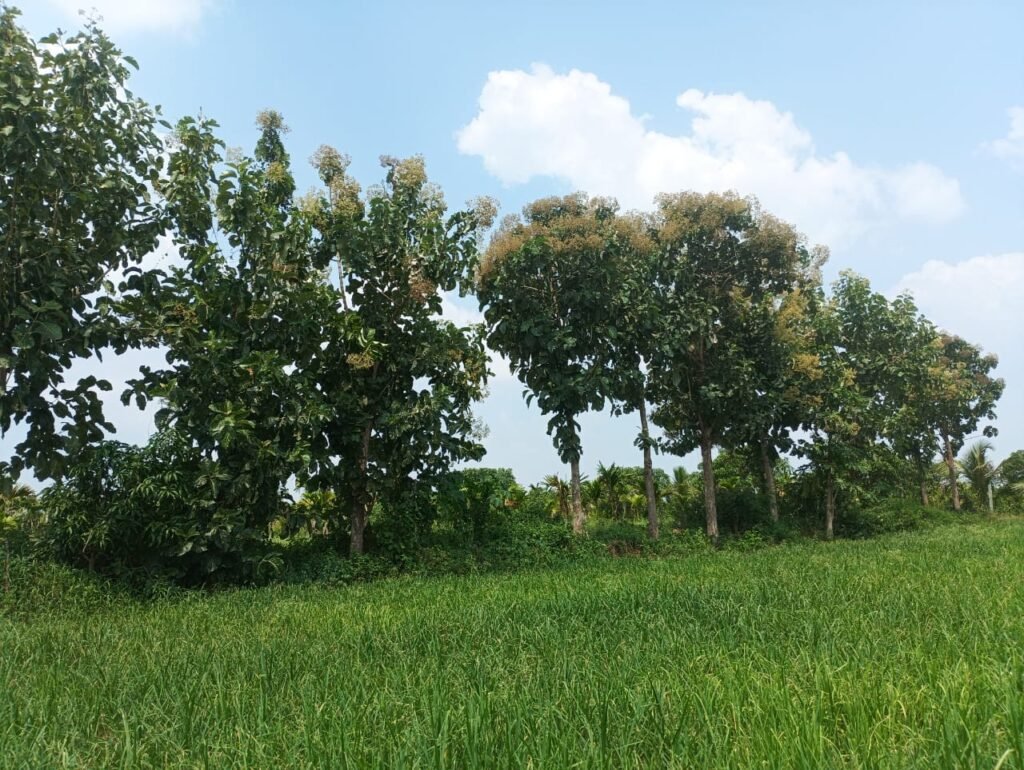
For some farmers, teak can become one component of a diversified farming system rather than the only source of income. This is highly relevant where trees can be integrated with crops and livestock.
4. Scope for agroforestry
Teak need not always be considered only as a pure plantation crop. Where site conditions, farmers’ objectives, and management permit, tree-based farming systems can provide diverse opportunities for integrating trees with agricultural production. However, the choice of spacing, associated crops, and management practices, including thinning and pruning, must be based on local conditions.
5. Environmental benefits
Trees can contribute to carbon storage, soil protection, and landscape-level environmental benefits. But these benefits should not be assumed automatically. The ecological outcome depends on where teak is planted, how it is managed, what it replaces, and whether the plantation is part of a diverse landscape or a large monoculture plantation.
What are the Concerns?
This is where I think the discussion needs to become more practical way. Planting teak is only the beginning. The real success will depend on how well the trees grow, how farmers manage them and whether they can benefit from them in the future.
Quality Planting Material
The success of the Tegada Siri scheme cannot be measured only by the number of seedlings distributed.
One crore seedlings planted per year for three years does not mean three crore productive trees.
Good-quality planting material, suitable sites, proper nursery practices and good management are essential for healthy growth and quality timber.
The Long Waiting Period
Teak is a long-term investment (normally requires around 15 years even in favourable sites), unlike a seasonal crop. Farmers may have to wait 15-20 years before getting significant returns. During this period, trees may face drought, fire, pests, diseases and other risks. Farmers also have to bear the cost of planting and maintenance. Therefore, farmers should clearly understand the time, cost, risks and expected returns before planting teak.
Market Uncertainty
A farmer planting teak today is investing in a future market. Timber prices, demand, regulations, and market conditions may change over the years. Therefore, planting should go along with proper market planning and clear information about future opportunities with proper planning.
Harvesting and Transportation
An important question is what happens when the trees are ready for harvest. Farmers need clear information about tree ownership, felling rules, permits, transportation, and marketing. A tree has little value to a farmer if it cannot be harvested, transported, and sold easily under clear and practical rules.
What About Other Native Trees?
Karnataka has many valuable native tree species with ecological, cultural and economic importance. A strong focus on teak should not reduce interest in other suitable native trees. Forestry is not about one species alone. Teak promotion should therefore be part of a broader tree-based farming and agroforestry approach, where different species are selected according to the site and farmers’ needs.
Ecological Considerations
Teak is a valuable timber species, but large-scale planting also needs ecological consideration. We should think about site suitability, water availability, soil, biodiversity, associated vegetation, and competition with crops. Most importantly, existing natural vegetation should not be replaced simply to increase teak planting.
The basic principle should be simple:
The right tree, in the right place, for the right purpose.
For me, the success of Tegada Siri should therefore be measured not only by how many teak seedlings are planted, but by how many survive, grow into quality trees, and finally provide real benefits to farmers without compromising the ecology and environment.
How Many Trees Will Survive and Become Valuable?
For me, this is the most important question about Tegada Siri.
A programme may begin with a target of planting one crore teak saplings every year for three years.
That is certainly a large ambition.
But after 10, 15, 20 or more years, what will matter is not the number of seedlings initially distributed.
What will matter is:
- How many trees survived?
- How well did they grow?
- What proportion developed quality stems?
- How many farmers continued managing them?
- What did farmers spend on establishment and maintenance?
- What income did farmers eventually receive?
- Could farmers legally and practically harvest and sell the timber?
- Was there a reliable market?
- What was the ecological impact?
- Did the programme create a productive long-term timber resource?
The real success of a programme should therefore be measured over decades, not just in the initial plantation phase.
Can Tegada Siri Help Long-Term Teak Supply?
Personally, I say yes, but it should be viewed as one component of a much larger strategy. India’s future timber requirement cannot be addressed simply by planting more teak. It requires a combination of scientific silviculture, quality planting material, tree improvement, farm forestry, agroforestry, appropriate land-use planning, farmer awareness, market development, processing infrastructure, clear regulations, and many more.
Research institutions also have an important role. We already have considerable knowledge of teak silviculture in India. The challenge is to ensure that this knowledge reaches the people who actually grow the trees.
I strongly encourage scientists to create awareness through radio talks, hands-on training, and popular articles, rather than focusing only on publishing papers in high-impact-factor journals.
Research becomes more meaningful when its knowledge reaches farmers, students, field workers, and the wider public.
My Perspective as a Forester
For me, Tegada Siri is not simply about planting teak. For us, it is an opportunity to examine whether a long-rotation timber species can be developed into a scientifically managed, economically viable, and farmer-centred tree resource.
If the programme is implemented on suitable land, supported with quality planting material, backed by scientific guidance and accompanied by clear information on harvesting, transportation and markets, it may create a valuable long-term resource.
At the same time, in realistic. Teak is a long-term investment, not a quick-income crop.
Farmers should know the risks before planting. Ecological suitability should be considered before expansion. Other valuable native tree species such as Toona ciliata, Chukrasia tubularis, etc. should not be overlooked. And most importantly, the farmer should remain at the centre of the programme.
For me, the real question is therefore not:
How many teak seedlings can Karnataka plant?
It is:
How many healthy, high-quality teak trees can be successfully established, managed and eventually converted into real economic value for farmers while maintaining ecological balance?
That is what will determine whether Tegada Siri becomes more than a tree-planting programme.
It could become a long-term experiment in forestry, agroforestry, farmer economics and sustainable timber production.
As a forester and a Kannadiga, I find that possibility worth watching.
In my upcoming blog, I will discuss some practical aspects of teak cultivation, including quality planting material, planting and spacing, thinning and pruning, water management, and nutrient management. These are important aspects to consider if Tega Siri is to become a successful long-term teak development programme involving farmers.

