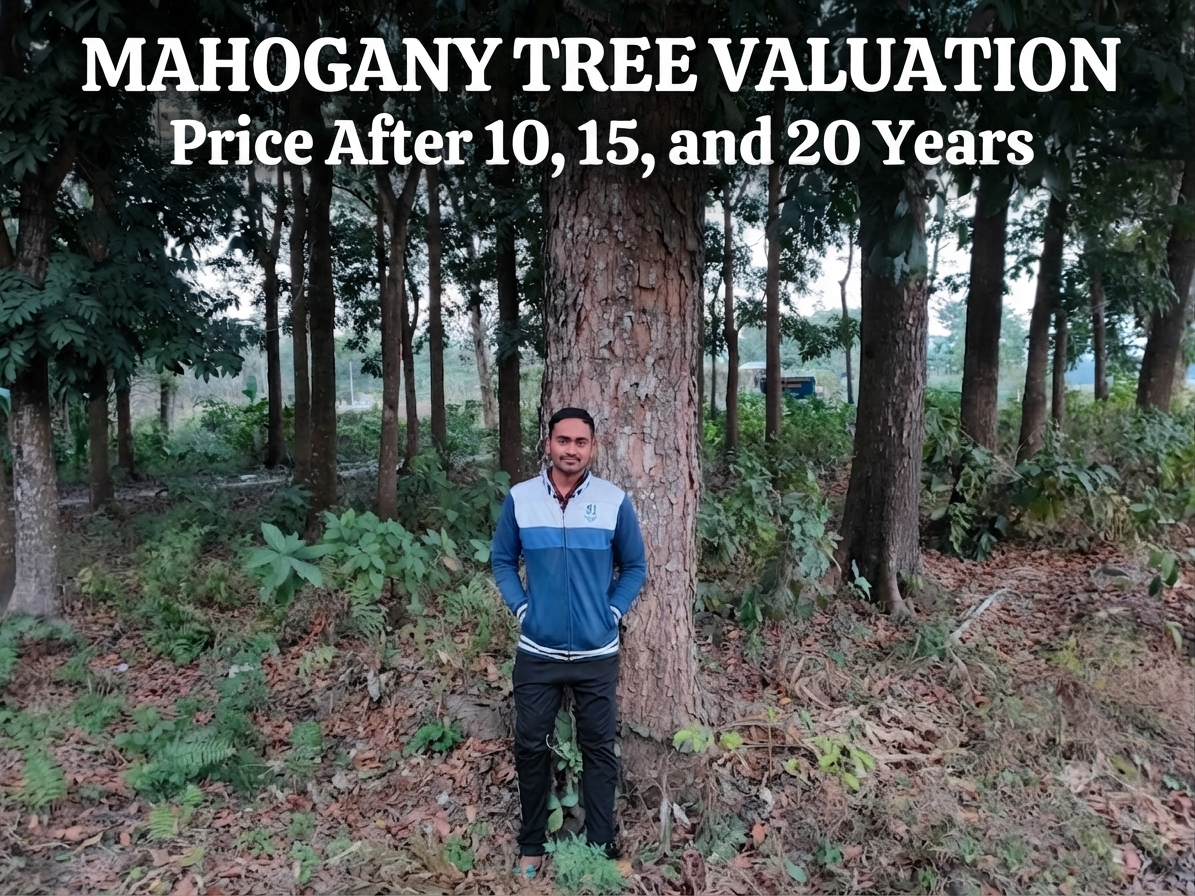
One of the most common questions people search for on our blog, Where agroforestry meets agriculture, is: What is the price of a mahogany tree after 10, 15, or 20 years?
However, before calculating the possible value of a mahogany tree, it is important to understand one simple fact: the price of a tree does not depend only on its age, but it depends largely on how well it grows in an area .
Otherwise, you can continue.
While writing this, initially, one major question comes to mind.
Why does Swietenia macrophylla produce larger timber than Swietenia mahagoni ?
In my understanding, S. macrophylla (Broad-leaf Mahogany) tends to become a larger tree and may produce greater timber volume than S. mahogani . One important reason is its greater genetic potential for height and stem diameter growth.
Another factor is its larger leaf size and dense canopy . A broader leaf area can provide a much greater capacity to capture sunlight and carry out photosynthesis, which helps the tree produce more carbohydrates for growth when adequate water, nutrients, and sunlight are available. S. mahagoni is generally a smaller tree and may have lower growth potential for height and diameter under comparable conditions.
Kindly note genetics and environmental (G X E) conditions .
Therefore, the final timber size is influenced by a combination of genetics, leaf and canopy development, photosynthetic activity, soil quality, moisture availability, climate, sunlight, spacing, and management .
In addition , personally, I observed that
Mahogany well thrives in tropical climate than subtropical climates, with a temperature range of 22-32°C.
It enjoys receiving higher (>1750 mm) annual rainfall, but with well-drained, deep, and fertile loamy soils.
I feel that altitude matters LOT . I never underestimate the European foresters who introduced mahogany to Indonesia, Malaysia, Bangladesh, and Kolkata (West Bengal). You just look at the growth of OUR two Indian mahogany tree species (Toona ciliata and Chukrasia valutina What fabulous growth, reaching great heights that seem to touch the clouds! Williamnagar in Meghalaya and the places in the erstwhile undivided North Bengal where Dietrich Brandis worked extensively while producing the Indian Method of Yield Regulation (Brandis Method) , and you will understand the difference.
Mahogany relatively performs well in soil that is slightly acidic to neutral pH may be around 6-8 .
The trees growing along the boundaries performed better than those growing inside. I strongly suggest boundary planting for farmers with limited land who depend on crops for their livelihood. In contrast, a plantation can be established by those who have larger areas of land, including working professionals who may not be able to devote much time to regular farm management.Fertile soils are an added advantage .Adequate sunlight, rainfall, soil moisture, and drainage are important. The quality of the seed source or planting material is also important .Inspiringly, I also observed a few dryland farmers growing mahogany with good growth comparable to that seen in the Bengal plains, largely due to the regular application of cow dung, integrated farming practices, and adequate irrigation.
Note: Mahogany is not native to India. Different mahogany species were introduced into parts of South and Southeast Asia, including Indonesia, Malaysia, and Bangladesh, during the colonial period, before being planted in gardens, institutional campuses, and plantation areas in India. Its attractive, durable, and workable timber made it commercially valuable for furniture, interior work, decorative wood products, and other high-value timber applications . This commercial potential encouraged wider planting.
Growth Rate Matters More Than Tree Age
Before asking about the price of a 10-, 15- or 20-year-old mahogany tree, first ask:
How fast is it growing on your farm?
For luxuriant growth, several factors play an important role as discussed earlier, including:
Soil pH and fertility
Soil moisture and drainage
Nutrient availability
Climate and rainfall
Altitude
Adequate sunlight
Quality of seed source or planting material
Note: Mahogany should generally be avoided in locations with prolonged waterlogging, extremely poor soils, severe moisture stress, or climatic conditions unsuitable for the species being planted.
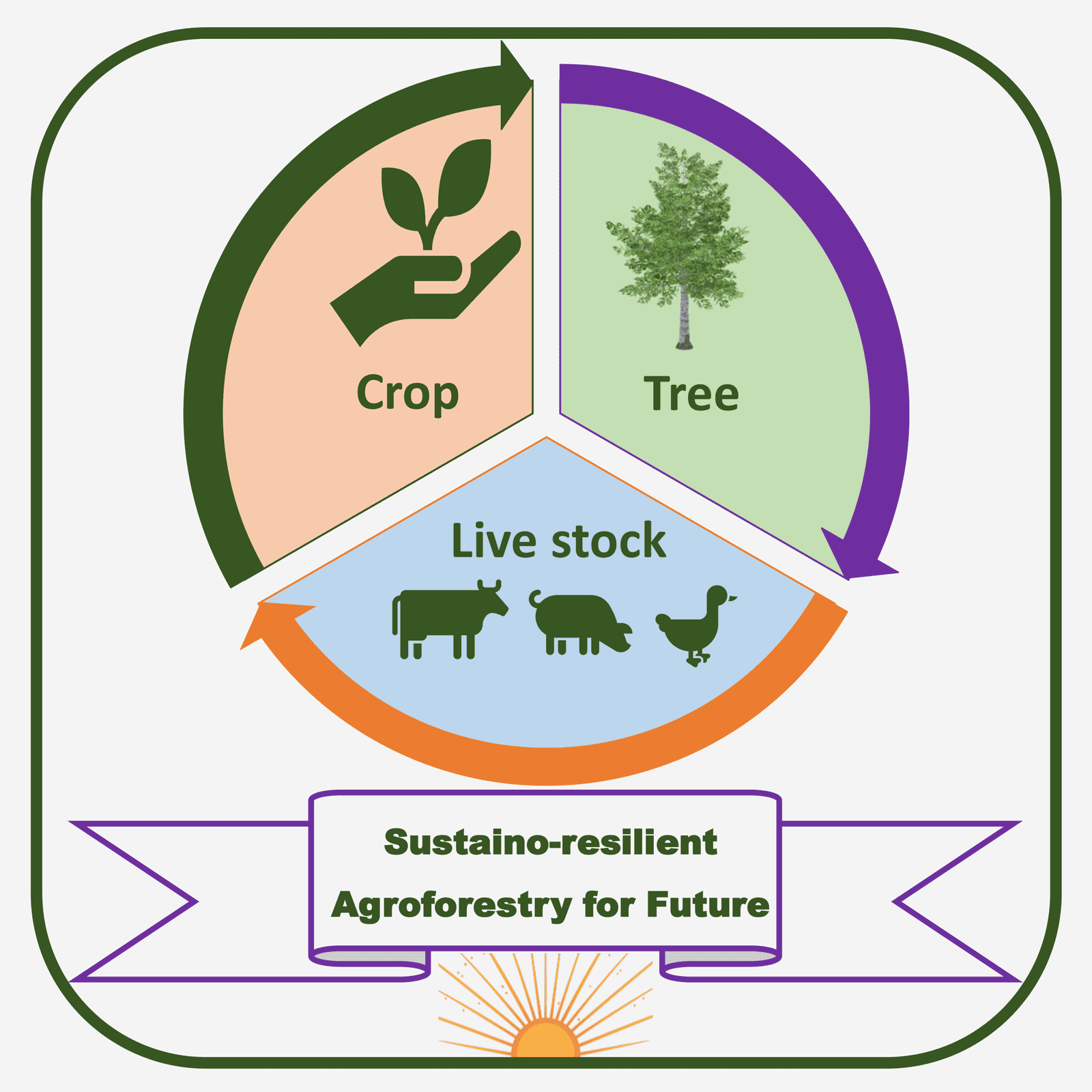
From an agroforestry perspective, boundary planting or wider spacing with intercropping can be more practical than closed or very high-density plantations , particularly for farmers who want to use the land for annual crops during the early years. Depending on spacing and canopy development, intercropping may be possible for around 4–5 years, or until the tree canopies begin to close .
What Could a Mahogany Tree Be Worth?
If growth is good, a mahogany tree may reach a commercially useful diameter by around 15 years , although this can vary enormously between locations.
As a broad example, a well-grown tree of around 15 years in a good site may reach approximately 25–45 cm in diameter and potentially produce around 0.5–1.0 cubic metres of timber . Depending on timber quality, log dimensions, local market conditions, and legal requirements, timber prices may vary considerably. If a farmer receives approximately ₹2,000–4,000 per cubic foot , a well-grown tree can be worth a substantial amount.
For example, 35 cubic feet × ₹3,000 = ₹1,05,000 in gross timber value. But this should not be considered a guaranteed income. The actual amount depends on timber recovery, quality, transportation, harvesting costs, local buyers and applicable regulations.
10, 15 or 20 Years? Location Makes the Difference
In the long term, one cannot predict mahogany tree price simply by counting the number of years after planting .
Personally, I have observed farmers in parts of North Bengal growing exceptionally well-performing trees that may approach around 1 cubic metre of stem volume within 15 years under favourable conditions and good management . In contrast, in drier regions, such as some parts of Karnataka, the same level of growth may take much longer, even 25–30 years or more, depending on irrigation, soil conditions, and nutrient management.
Another important point is that mahogany timber trade and harvesting may be subject to regulatory and documentation requirements , especially because certain mahogany species are listed under CITES. Farmers should therefore understand the legal requirements related to harvesting, transport, processing and sale before establishing a commercial plantation.
The bottom line is simple: Mahogany tree price is not determined by the number of years the tree has been standing. It depends on the right species, right planting material, right soil and climate, good management, and above all, your patience, persistence, and hard work. Before planting thousands of trees, first understand your farm and find out whether mahogany is truly suitable for your local conditions.
Estimated Mahogany Tree Price After 10, 15 and 20 Years
The following table provides a general illustration only . Actual diameter, timber volume and market value can be significantly higher or lower depending on the planting material, spacing, soil, climate, irrigation, management, timber quality and local market.
Tree age Possible growth stage Estimated timber potential* Possible gross timber value** 10 years Medium-sized tree (Growth varies greatly with site) May not yet have reached an optimum exploitable diameter in many locations Highly variable; depends on diameter, log quality and local buyer 15 years Under favourable conditions, few trees may reach a commercially useful diameter A well-grown tree may potentially yield around 0.5–1.0 m³ in exceptional or favourable situations At around ₹1,500 to ₹3,000 per cubic foot , (Gross value could range widely) 20 years Larger diameter and potentially greater timber recovery in good sites. Usually greater volume than at 15 years if growth remains good Potentially higher, but depends on actual log dimensions and timber quality.
Note:
*These figures should not be treated as a guaranteed yield per tree.
For example, if a particular tree actually produces 35 cubic feet of saleable timber and receives ₹3,000 per cubic foot , its gross timber value would be approximately:
35 cubic feet × ₹3,000 = ₹1,05,000
However, farmers should be careful with advertisements claiming that every mahogany tree will produce ₹1 lakh or several lakhs after a fixed number of years . That is not scientifically reliable. A tree must first achieve the required diameter, height, stem form, and recoverable timber volume. Some current plantation-market sources in India quote plantation-grown mahogany prices in the broad range of approximately ₹1,500–₹2,500 per cubic foot, although prices vary considerably by location, buyer, and timber quality.
Does a Mahogany Tree Need 10, 15 or 20 Years to Become Valuable?
There is no single answer.
Under favourable soil, climate and management conditions, some mahogany trees may reach a useful commercial size by around 12–15 years . In less favourable locations, particularly under moisture stress or unsuitable soil conditions, achieving the same size may take much longer.
Personally, I have observed farmers in parts of North Bengal achieving exceptionally good tree growth, where individual trees may approach around 1 cubic metre of volume within approximately 15 years under favourable conditions and management . In contrast, in drier and more arid regions, the same level of growth may take considerably longer, even with irrigation and nutrient management.
This is an observation-based comparison rather than a universal growth prediction.
A Note on CITES and Legal Requirements
An important point for commercial growers is that mahogany is not a single species . Different species may have different regulatory status. Swietenia macrophylla and other species within the genus Swietenia are included in CITES controls, with S. macrophylla listed in Appendix II. CITES primarily regulates international trade, while domestic harvesting, transport, and processing requirements can depend on national and state-level forest department laws and documentation.
Note: Before planting, harvesting or selling timber, farmers should check the current rules applicable in their state and local area , particularly regarding tree felling, transit, transport and commercial processing.
FAQs About Mahogany Tree Price
1. What will be the price of a 10-year-old Mahogany tree?
How can one size or one price fit all? The value depends on the tree’s genetics, environment, age, diameter, height, usable timber volume, wood quality, and the local market. A 10-year-old tree growing on an excellent site, such as in North Bengal, may outperform a 15-year-old tree growing under poor conditions in the central arid region of Karnataka.
2. How much can a 15-year-old Mahogany tree be worth?
A well-grown Mahogany tree at 15 years under favourable conditions may have significant timber value, but you can’t estimate it accurately from age alone. First, measure the tree’s diameter and estimate its merchantable volume. Then use the local timber price, the cost of timber harvest and transport, and potential end use to calculate an approximate gross value.
3. Can one Mahogany tree really give ₹1 lakh?
Yes, certainly. It is possible for an individual, exceptionally well-grown tree with sufficient saleable timber volume to have a gross value of around ₹1 lakh under a favourable price scenario.
For example, 35 cubic feet at ₹3,000 per cubic foot equals ₹1.05 lakh .
Note: However, this should never be considered a guaranteed return for every tree.
4. What is more important: tree age or tree diameter?
For timber value, diameter, merchantable volume and wood quality are generally more important than simply counting the number of years since planting .
5. Should I plant mahogany in my farm?
No. Before planting, understand your soil, rainfall, temperature, moisture availability, altitude and local market. A tree that performs exceptionally well in one region may grow slowly in another.
Is it possible to ask yourself that How well can this tree grow on my farm? instead of asking question: “How much will my tree be worth after 10, 15 or 20 years?”
Mahogany tree price is not determined simply by the number of years after planting. It is the result of choosing the right species, good-quality planting material, a suitable site, proper spacing, soil and moisture management, and many years of patience, persistence and hard work .
If your farm is genuinely suitable for mahogany and the trees receive proper management, a well-grown tree can potentially become a valuable long-term asset. But before planting thousands of saplings based on attractive income claims, start by understanding your land, climate and local regulations, and, if possible, begin with a small trial plantation first.
6. Why One Mahogany Tree Grows Faster Than Another
It is the most important part of mahogany farming.
Imagine two farmers planting mahogany on the same day. After 15 years, one farmer may have trees with excellent height and diameter growth, while the other may still have relatively small trees. Both plantations are 15 years old, but they do not have the same timber value.
The difference can be caused by:
Quality of seed source or planting material
Soil pH, depth, and fertility
Soil moisture and drainage
Rainfall and temperature
Altitude and climate
Availability of sunlight
Spacing between trees
Irrigation and nutrient management
Weed control and protection
Overall farm management
Note: Farmers should first study their farm and climatic conditions before planting mahogany on a large scale.
7. Is Boundary Planting Better Than High-Density Mahogany Plantation?
For small landholding (marginal) farmers, boundary planting or wider spacing with intercropping may be more practical than very dense planting .
Mahogany takes 10 years to develop a large canopy. During the initial years, the space between widely spaced trees can potentially be used for compatible crops. In many situations, intercropping may continue for approximately 5 years, or until canopy development and competition for sunlight become significant .
High-density planting may increase early competition among trees and can affect diameter development if thinning and management are not properly planned.