Every plant, every person, and every farming practice has a story.
What if all these unique stories were documented and explored for the greater good?
Stories of people who have used plants for generations, farmers who have cultivated them, forests where they naturally grow, and researchers like us who are trying to understand and conserve them.
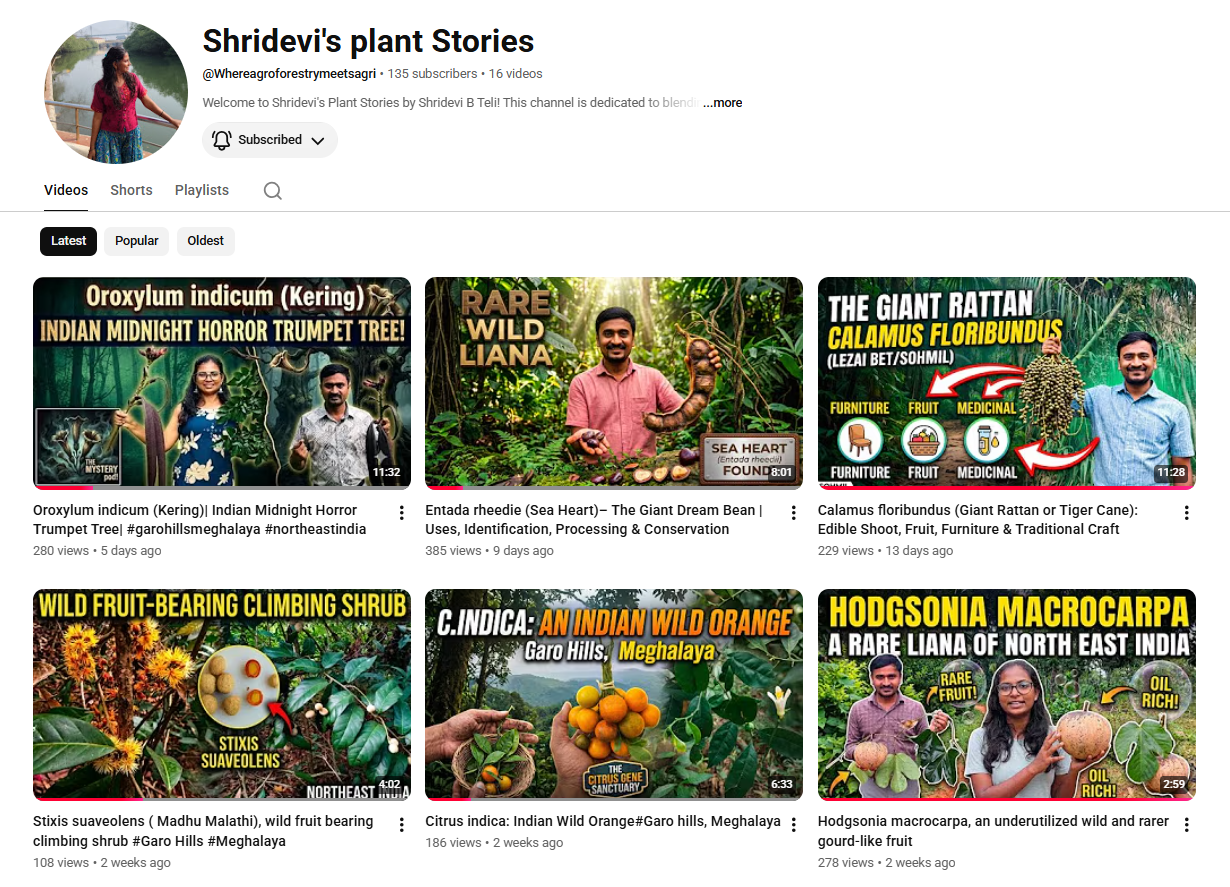
This idea is at the heart of Shridevi’s Plant Stories, our YouTube channel complementing this blog, Where Agroforestry Meets Agriculture.
Through this channel, we want to take you beyond ordinary plant videos and gardening stories. Every weekend, we will introduce you to fascinating, lesser-known, useful, and often forgotten and underutilized plants, especially from the rich Indo-Burman Biodiversity Hotspot and the diverse landscapes of Northeast India.
From rare wild fruits to edible forest plants, there are so many fascinating plants waiting to be discovered.
We will explore fruit trees, climbers, medicinal plants, rattans, bamboo, and many useful trees and shrubs.
We will also look at their role in agroforestry and farming.
Our aim for the next few years is simple.
We want to help people, students, and researchers discover these plants, understand their importance, and explore their potential for sustainable agriculture and better livelihoods.
Why Did We Start Shridevi’s Plant Stories?
Today, we can easily find information about popular agricultural and horticultural plants such as mango, banana, tomato, and rose. But what about the hundreds of rare and lesser-known plants growing quietly, yet slowly disappearing from our forests, along roadsides, in villages, and in traditional homegardens?
Many of these plants are valuable and serve multiple benefits, including food, medicine, nutrition, fibre, oil, timber, or other products.
An ancient Sanskrit saying beautifully expresses plant uses as:
अमन्त्रमक्षरं नास्ति, नास्ति मूलमनौषधम् ।
Subhāṣita Ratnākara, 233.29; also attributed to Samayocitapadyamālikā.
अयोग्यः पुरुषो नास्ति, योजकस्तत्र दुर्लभः ॥
Amantṛam akṣaraṃ nāsti, nāsti mūlam anauṣadham I
Ayogyaḥ puruṣo nāsti, yojakastatra durlabhaḥ II
It means:
There is no letter that cannot become part of a mantra, no root or plant that is without medicinal value, and no person who is entirely without ability. What is rare is someone who can recognize and make the right use of them.
Some of these plants have been used by indigenous communities for generations. Yet many of them remain poorly known outside their local regions.
Some are also becoming increasingly difficult to find because of habitat loss, changing food habits, overharvesting and the gradual disappearance of traditional knowledge. This is particularly important in Northeast India, one of the biologically and culturally rich regions of the country.
Our channel was created to tell the stories of these plants in a simple and engaging way.
We want to ask questions such as:
What is this plant?
Where does it grow?
How do local communities use it?
Can it be propagated?
Can farmers cultivate it?
Can it be integrated into diverse agroforestry systems?
Could a forgotten plant become a future source of invention as well as income?
These questions connect directly with the philosophy of Where Agroforestry Meets Agriculture.
From Forest to Farm
One of the most interesting aspects of our work is the connection between forests and farming.
Many useful plants that occur naturally in forests may also have potential for cultivation. However, conservation and commercialization should go hand in hand without exploitation.
Unscientific harvesting of plants from the forest is not a sustainable solution.
Instead, we need to understand how these species can be conserved, propagated, and, where appropriate, cultivated under suitable agroforestry systems.
For example, a rare edible climber may naturally grow using trees as support. Instead of removing it from the forest, could we develop a propagation technique and grow it with suitable support trees on farms?
Imagine growing rare Blood Fruit (Haematocarpus validus), Lard Fruit (Hodgsonia macrocarpa), or Eastern Uvaria (Uvaria hamiltonii) on native trees as part of commercial agroforestry in the Garo Hills of Meghalaya.
Could this help strengthen agroecology, conserve these valuable plants, and create better livelihood opportunities for local communities?
This is where agroforestry becomes particularly important.
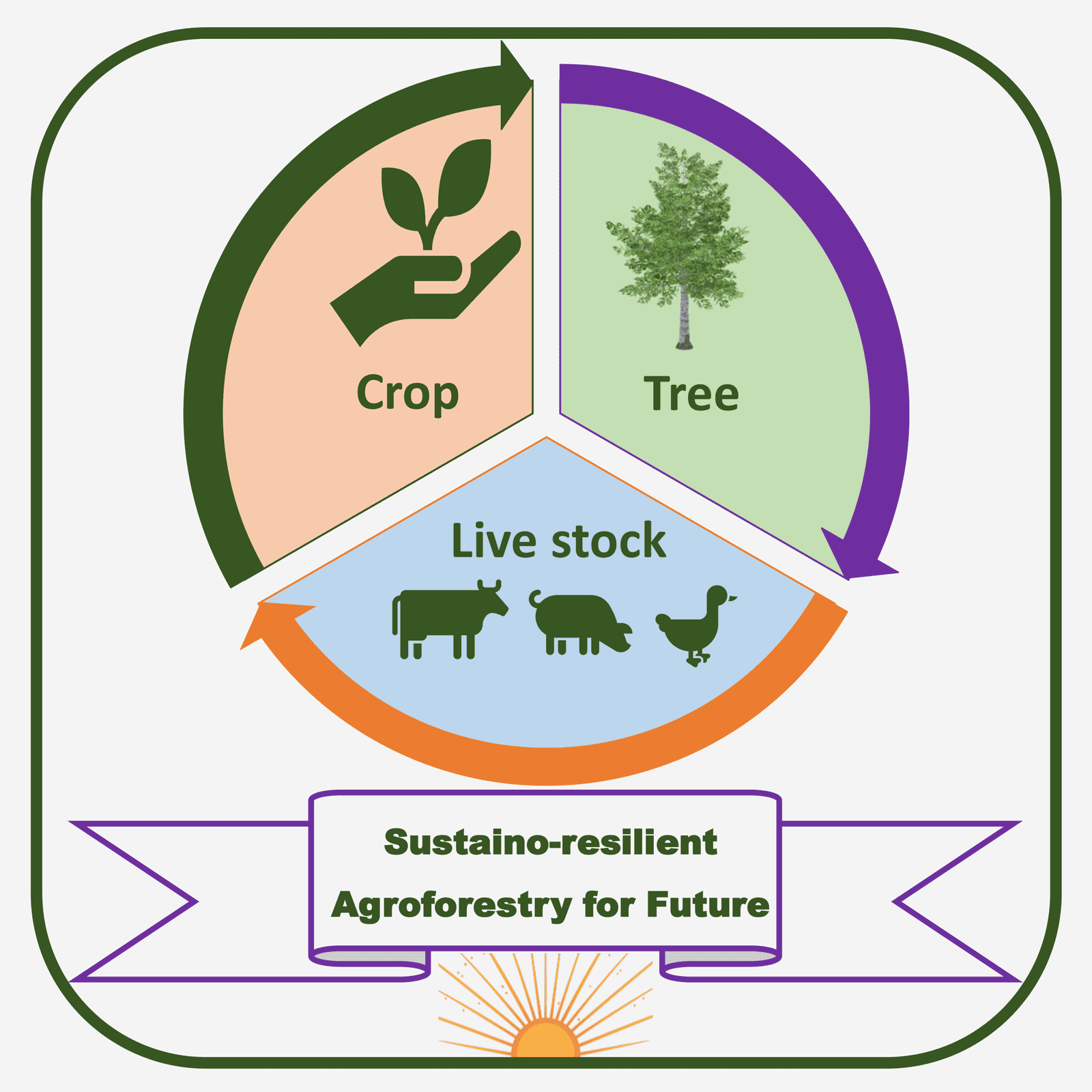
Agroforestry combines trees with crops, livestock, or other agricultural components to create productive and ecologically sustainable systems.
Through our videos, we hope to show how traditional knowledge and modern scientific approaches can work together.
Discovering Rare and Forgotten Plants
One of the major themes of Shridevi’s Plant Stories is lesser-known and underutilized plants.
Some of these plants are rarely discussed outside their native regions.
For example, we explore fascinating species such as Blood Fruit (Haematocarpus validus), Burmese Grape (Baccaurea ramiflora), Lard Fruit (Hodgsonia macrocarpa), Sea Heart (Entada rheedie), and other species.
These plants are not simply botanical curiosities.
They can have important connections with traditional food systems, forest ecology, biodiversity conservation and rural livelihoods.
By documenting these rare plants, we hope to introduce their stories to a much wider audience.
Science Made Simple
Scientific information can sometimes appear complicated.
Terms such as germination percentage, vegetative propagation, auxins, agroforestry systems, phytochemicals and genetic diversity may sound difficult to people who are not researchers.
Our goal is to make this information easier to understand. Instead of simply presenting scientific terminology, we try to explain:
What does it mean?
Why does it matter?
How can it be useful?
We hope this approach allows students, farmers, gardeners, nature lovers and researchers to learn from the same content at different levels.
Can Forgotten Plants Become Future Crops?
One question particularly interests us:
Can a forgotten plant become a future crop?
A plant may have nutritional value, medicinal importance or a valuable fruit, but that alone does not make it suitable for large-scale cultivation.
We need to understand its propagation, growth requirements, productivity, market potential, and compatibility with existing farming systems.
This is where research becomes important.
Through our videos, we explore the journey from:
Forest → Research → Propagation → Cultivation → Agroforestry → Value Addition → Livelihood
This approach can potentially create new opportunities while reducing pressure on natural populations.
Why Northeast India?
Northeast India is home to extraordinary plant diversity.
The region’s forests, hills, villages and traditional agricultural systems contain numerous plants that remain unfamiliar to much of the outside world.
Meghalaya, in particular, has a remarkable diversity of wild edible plants, traditional crops, climbers, bamboos, rattans, medicinal plants and multipurpose trees.
Our field experiences allow us to bring some of these plants directly to your screen.
More Than a YouTube Channel
Shridevi’s Plant Stories is not intended to be just another collection of plant videos.
It is an extension of our broader interest in agroforestry, biodiversity conservation, traditional knowledge and sustainable agriculture. And perhaps most importantly, between the plants we already know and the plants we are slowly forgetting.
Join Us on This Journey
If you enjoy plants, forests, farming, biodiversity, traditional food, agroforestry, or simply discovering something new plants, we invite you to join Shridevi’s Plant Stories.

